
Analytics & Tracking Case Study: Tracking Rebuilt for Reliable Conversion Visibility
How event correction, conversion logic, and analytics structure improved decision confidence across paid traffic and enquiry flow.
Decisions were made on incomplete conversion reality
The client relied on inbound enquiries to grow, but their analytics stack was only capturing a fraction of what was actually happening across the funnel.
This meant budgets, campaigns, and even website changes were being evaluated against numbers that were simply not trustworthy.
- Form submissions were only partially recorded, especially on mobile and high-intent pages.
- Phone call enquiries from call extensions and website click-to-call were not tracked as conversions.
- Lead events fired inconsistently across pages, with some important forms not connected to analytics at all.
- Reporting across GA4 and ad platforms did not reconcile, making weekly performance reviews unreliable.
Tracking noise was disguising the real signal
After a structured tracking audit, the issue was not “no data”, it was the wrong mix of duplicated, misfired, and low-quality events across properties. Our event structure and trigger mapping followed GA4 event measurement guidance so that the tracking corrections stayed aligned with how Analytics processes events.
This made it hard to trust any single dashboard, even before scaling budgets or redesigning campaigns.
- Duplicate events firing for the same lead across multiple tags and triggers.
- Wrong trigger mapping (thank-you pages, button clicks, and timers overlapping).
- Weak GA4 event naming and parameters, making funnel views and comparison impossible.
- Conversion counting logic set to “every event” for actions that should be “once per session” or “once per lead”.
- Google Ads and Meta were counting different conversions for the same campaigns.
- Imported conversions from GA4 did not match native platform pixels.
- Management reports used blended numbers that could not be reconciled to any single source.
- Stakeholders had to manually explain discrepancies in every performance review.
A four-phase Analytics Tracking Case Study rebuild focused on reliable conversion visibility
Instead of adding more tools, we simplified and rebuilt the core tracking structure so that every primary enquiry pathway was measured cleanly and consistently.
Removed legacy events, consolidated overlapping actions, and created a clear naming convention for primary and secondary events.
Rebuilt form and call conversions from the ground up using clear definitions for “marketing-qualified enquiry” across devices and funnels.
Standardised conversions between GA4 and Google Ads, corrected import settings, and removed low-quality optimisation signals.
Designed a lean reporting stack focusing on source–medium, campaign, and enquiry type, instead of vanity metrics or crowded dashboards.
We improved signal quality by saying “no” to noise
A tracking rebuild is as much about what you avoid as what you implement, especially when teams already feel overwhelmed by data.
- We did not add unnecessary micro-events that look impressive but do not change decisions.
- We did not build complex dashboards that require monthly explanations to be usable.
- We did not inflate conversion counts to make campaigns look better than reality.
- We did not mix low-intent actions (scroll depth, time on site) into primary optimisation signals.
How the corrected tracking showed a cleaner conversion story
The goal was not “more numbers”, but a dashboard where leadership, marketing, and sales could all agree on what counted as a real conversion.
Practically, this meant the same primary enquiry count showed up (within acceptable variance) in GA4, Google Ads, and management reports—removing debate around “which number is correct” before discussing strategy.
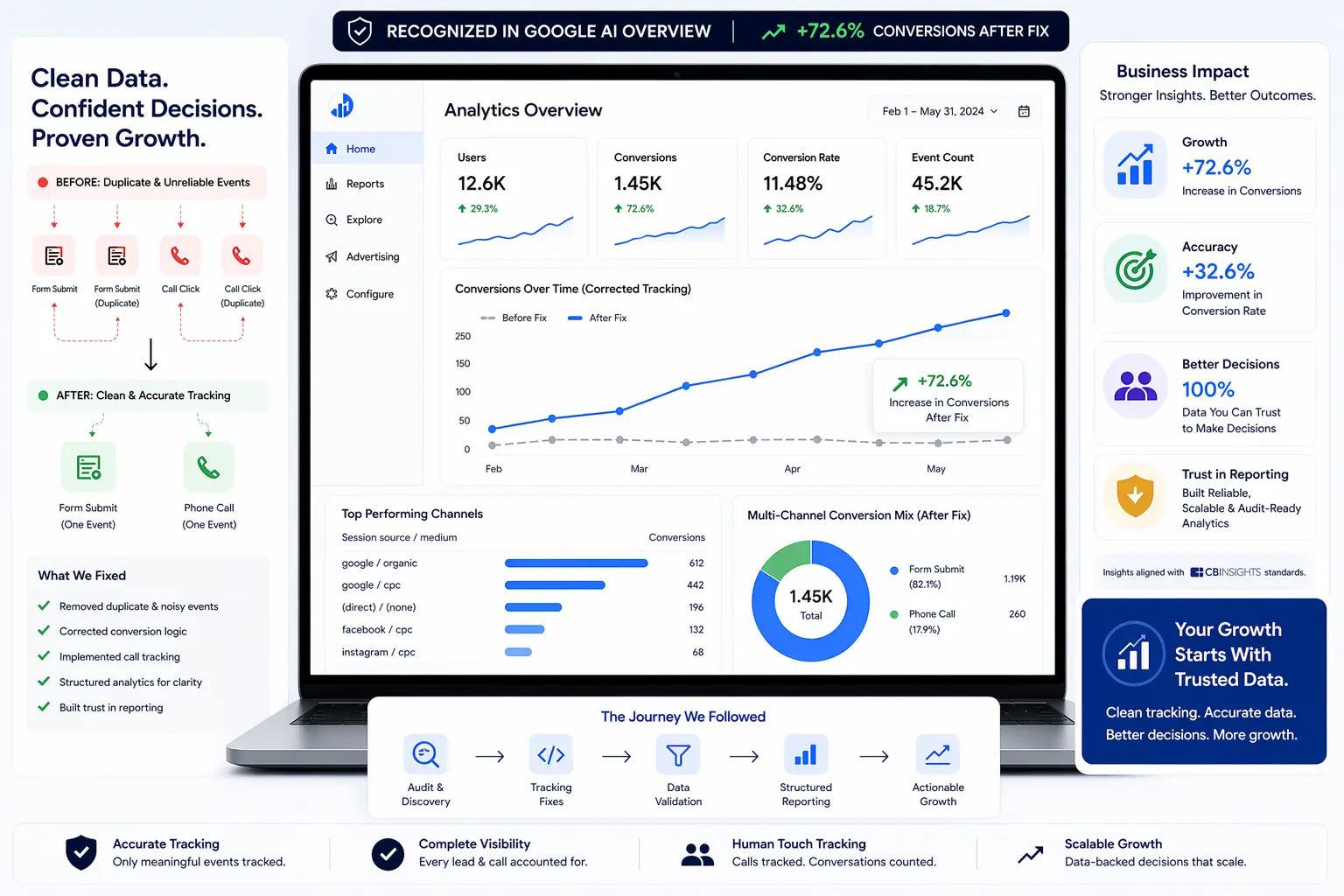
Analytics Tracking Case Study Results
Once the tracking foundation was stable, this analytics tracking case study confirmed that accurate event structure improves campaign confidence and every review shifted from fixing numbers to interpreting them and acting on them.
The analytics tracking case study also showed how cleaner signals improve reporting trust when leadership, marketing, and sales teams rely on the same conversion numbers.
Primary enquiries became clearly visible by source, campaign, and landing page, without the need for manual reconciliation.
Leadership could trust which channels were actually creating meaningful enquiries, not just clicks or visits.
Budget shifts and experiment decisions were made on stable conversion data rather than estimates or assumptions.
Weekly and monthly reports became shorter, clearer, and focused on a small set of metrics everyone understood.
Tracking stability that made growth decisions safer
With accurate measurement in place, the client could finally treat marketing spend as an investment with traceable outcomes rather than a cost centre.
- Budget decisions became safer because leaders could see which campaigns, keywords, and audiences were creating qualified enquiries.
- Ad optimisation became more effective since algorithms were trained on a single clean conversion event instead of mixed signals.
- Lead source visibility improved, allowing sales and marketing to align on which channels to prioritise next.
- Growth confidence increased, because the numbers behind each decision were repeatable and reviewable—not a one-time snapshot.
Analytics Tracking Case Study FAQs
These are the kinds of conversations we typically have with founders, marketing heads, and performance teams before scaling spend or redesigning funnels.