
Qualified Lead Flow Built Through Search Intent Systems
This Lead Generation Case Study outlines how search intent, landing clarity, and conversion tracking improved lead quality through structured Google Ads execution for a service business acquiring enquiries from Google Search.
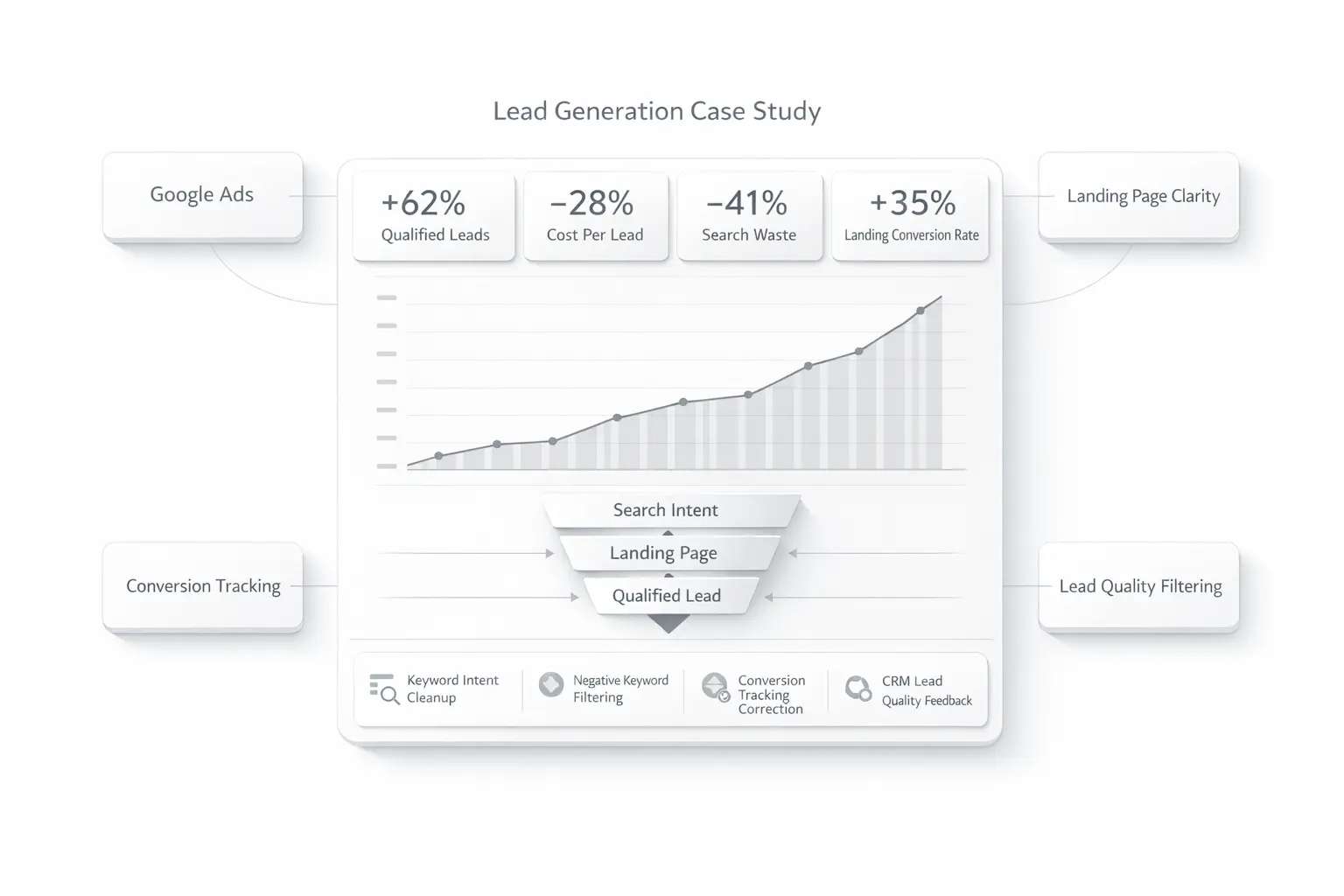
Measured lead quality improvement across six months through search intent cleanup, filtering and conversion correction.
Lead Generation Case Study: Volume Was Growing, But The Right Enquiries Were Not
The business was already investing in Google Search and generating a consistent stream of clicks and form submissions, yet the internal sales team reported inconsistent fit and weak lead quality across a large share of conversations.
- Clicks were arriving at a reasonable cost, but many enquiries were unqualified or outside the intended decision-maker profile.
- Search intent was mixed across campaigns, with generic and research-focused queries competing against high-intent, ready-to-engage traffic.
- The existing landing page lacked strong trust assets, clear positioning, and a guided enquiry journey, which diluted perceived value.
- Conversion signals inside Google Ads were incomplete, making it difficult to separate commercially meaningful leads from noise.
Why This Lead Generation Case Study Matters
For leadership teams evaluating search as a growth channel, this Lead Generation Case Study demonstrates how disciplined work on intent, landing clarity, and tracking can upgrade enquiry quality without relying on aggressive budget increases.
Before Scale, The System Needed Signal Clarity
Instead of adding more budget into an imprecise setup, we first examined how keywords, ads, landing experience, and tracking were working together and where signal distortion was introduced along the path from search term to sales conversation.
- Keyword targeting required cleanup, with overlapping themes and loosely related terms driving low-intent sessions.
- Negative keywords were missing in key ad groups, allowing irrelevant search terms to consume budget and pollute performance data.
- Landing friction — unclear messaging hierarchy and underused proof — reduced enquiry quality and made it harder for serious buyers to self-select.
- There was no reliable lead tracking baseline tying qualified outcomes back to campaign, keyword, and device-level data.
What We Did To Rebuild Lead Quality, Phase By Phase
The engagement was structured into defined phases so every change improved the quality of signals and decisions before any meaningful budget adjustments were made.
Consolidated campaigns around tightly themed, high-intent service keywords, removed generic research terms, and introduced layered negative keywords to cut obvious mismatch and visible search waste.
Reframed the landing page to state who the service is for, the outcomes it delivers, relevant proof, and a single focused enquiry path, while reducing distractions and simplifying high-intent form fields.
Audited all conversion events, removed low-signal micro-conversions from primary optimisation, and implemented reliable form, call, and high-intent events as the core optimisation layer.
Integrated CRM feedback into Google Ads, separated strong-fit from weak-fit leads, and used this insight to refine bid strategies, keyword mix, and device allocations over the 90‑day period.
What We Intentionally Did Not Do — And Why
In performance systems, what you choose not to do is as important as the initiatives you ship. We protected both budget and learning quality by deliberately avoiding several tempting but premature moves.
We did not increase daily budgets in the opening weeks, prioritising stability in keyword mix, landing performance, and tracking accuracy before amplifying spend.
We consciously avoided broad, exploratory keyword themes until exact and phrase terms consistently produced qualified, commercially relevant conversations.
Budget decisions were taken only after tracking, enquiry qualification, and landing performance were aligned, ensuring future scale preserved cost efficiency and lead quality.
A Clean, SaaS-Style View Of The Account After Correction
The visual below is an illustrative Google Ads dashboard-style block, showing how the account looked once spend, keyword intent, and qualified conversion signals were aligned.
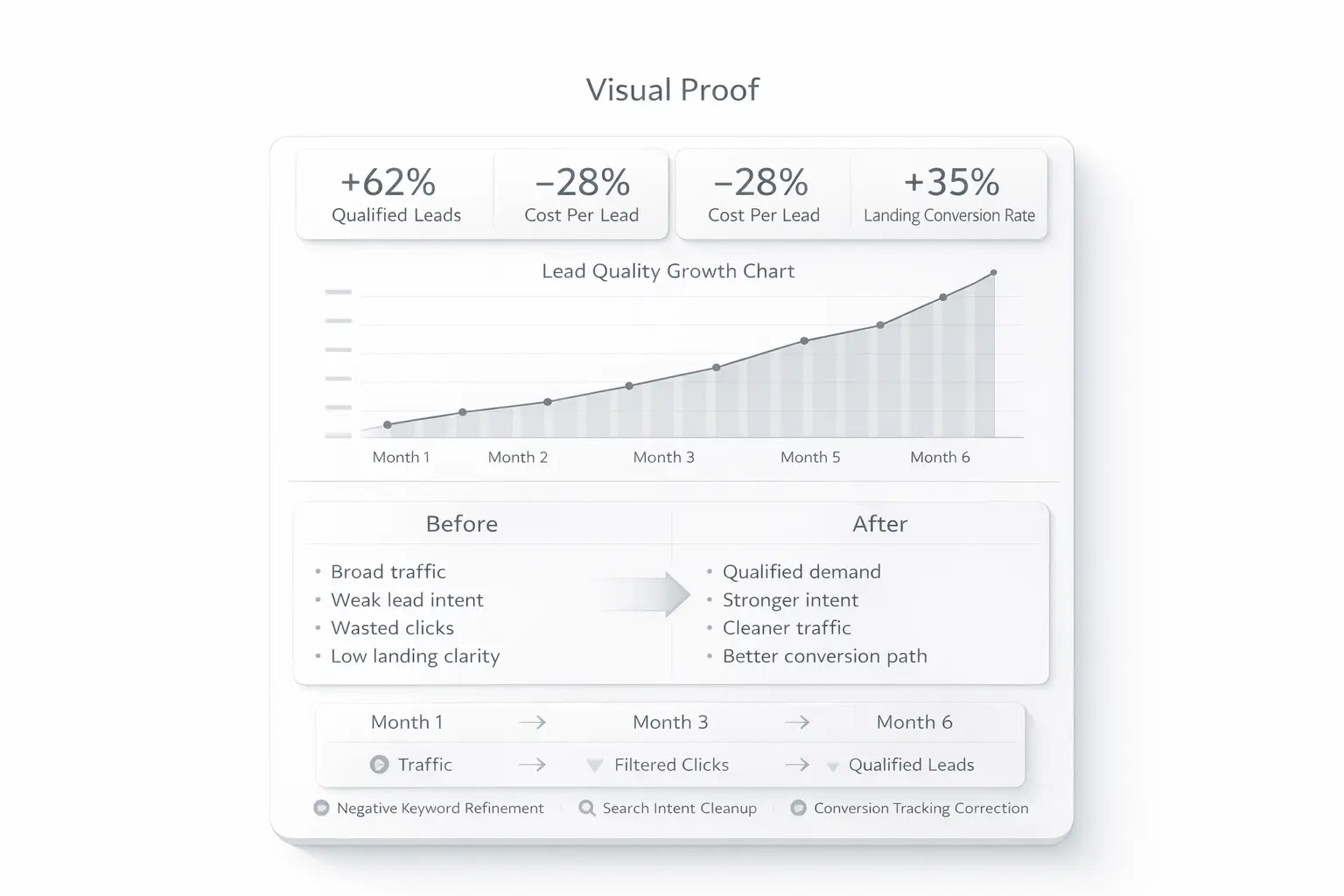
Visual proof of six-month lead quality improvement through filtering, stronger intent and conversion correction.
For teams that want to understand the underlying mechanics, we align our account structure with official Google Ads documentation so optimisation decisions remain consistent with platform best practices.
Results Across The First 90 Days In This Lead Generation Case Study
The proportion of enquiries matching the target profile increased, based on structured sales team feedback and CRM-level tagging captured for this Lead Generation Case Study.
Cost per qualified enquiry improved once low-intent traffic and weak conversion signals were removed from the optimisation model.
Budget previously consumed by irrelevant or low-intent queries was reallocated into proven, high-intent search themes.
Enquiry rate increased after restructuring messaging, proof assets, and form friction on the landing experience.
From “More Leads” To Confident Growth Decisions
With a cleaner mix of search intent and a landing experience aligned to the right buyer, sales conversations became more focused and substantive, increasing close rates and reducing time spent on misfit enquiries. The leadership team gained confidence in their marketing spend because each additional rupee now moved into a system with transparent keyword economics, clear lead quality, and reliable attribution to pipeline.
Instead of chasing volume, the business now operates a structured search system it can scale in controlled phases: deepen coverage around proven intent, test new themes on limited budgets, and adjust bids and messaging using a stable tracking layer that reflects real commercial outcomes.
Questions Decision-Makers Ask Before Scaling Search
Increasing spend on an unclear system multiplies noise rather than outcomes. In this Lead Generation Case Study, we first stabilised keyword mix, landing performance, and tracking so that every extra rupee reinforced a proven acquisition path instead of funding blind experimentation.
Google Ads can send the right traffic, but the landing experience decides whether serious buyers feel understood, reassured, and ready to enquire. Strong structure, clarity, and proof filter out weak intent and attract the conversations your sales team actually wants to handle.
We align with your sales team to tag strong-fit and weak-fit leads in the CRM, then connect that feedback back to campaign and keyword data, so optimisation is guided by real sales outcomes instead of surface-level conversion counts.
Without clean tracking, both algorithms and humans make decisions on partial or misleading signals. When tracking is accurate, you can confidently reallocate budget, test new tactics, and scale what is already demonstrably working in your market.
Strategic Detail, Shared In The Right Setting
Detailed keyword structures, bidding frameworks, and internal lead filtering logic are shared only during strategic consultation, where they can be shaped around your unit economics, market dynamics, and internal sales capacity.
Ready To Build A Search System Your Sales Team Trusts?
If you are a service business relying on Google Search for enquiries, we can help you architect a structured lead generation system across Google Ads, landing pages, and tracking — before you commit to materially higher budgets.