

Slow Website Meta Ads: 7 Hidden Reasons Campaigns Lose Performance and Profit
Most brands blame weak creatives or “tired audiences” when Meta campaigns stall. In reality, a slow website quietly turns strong ads into expensive noise long before your team sees the real opportunity.
Why Slow Website Meta Ads Results Feel Like “Weak Campaigns”
When decision makers review Meta Ads performance, the first instinct is to question targeting, creative, or offer. Slow Website Meta Ads performance feels like a marketing issue, while the real constraint sits in page load time and technical delivery.
A slow website affecting Meta Ads does not appear in your standard reporting language. The dashboard shows impressions, clicks, and maybe landing page views — it does not show the number of high-intent users who abandoned the wait before your brand ever had a chance to earn trust.
The result is a costly illusion: the marketing team iterates ad concepts while the core leak is happening between the first tap and the first meaningful pixel fire. In many accounts we review at MyProHub, fixing landing page speed Meta Ads issues creates more impact than rewriting the entire creative system.
Strategic point: if your landing page takes 4–7 seconds to become usable on mobile, your slow website Meta Ads problem is not just “UX.” It is a direct constraint on revenue, learning, and signal quality.
How Meta Ads Fail Before Users Even Truly Engage
Meta’s reporting often counts a “landing page view” when the page has technically loaded, not when the user has meaningfully interacted. On slow sites, this means your campaigns can report healthy traffic while the real experience is a half-rendered layout, blocking scripts, and delayed content.
Slow Website Meta Ads performance therefore fails earlier than most teams measure: users drop off while waiting for hero content, form fields, or call-to-action buttons to become interactive. The session exists in data, but the conversation never starts in reality.
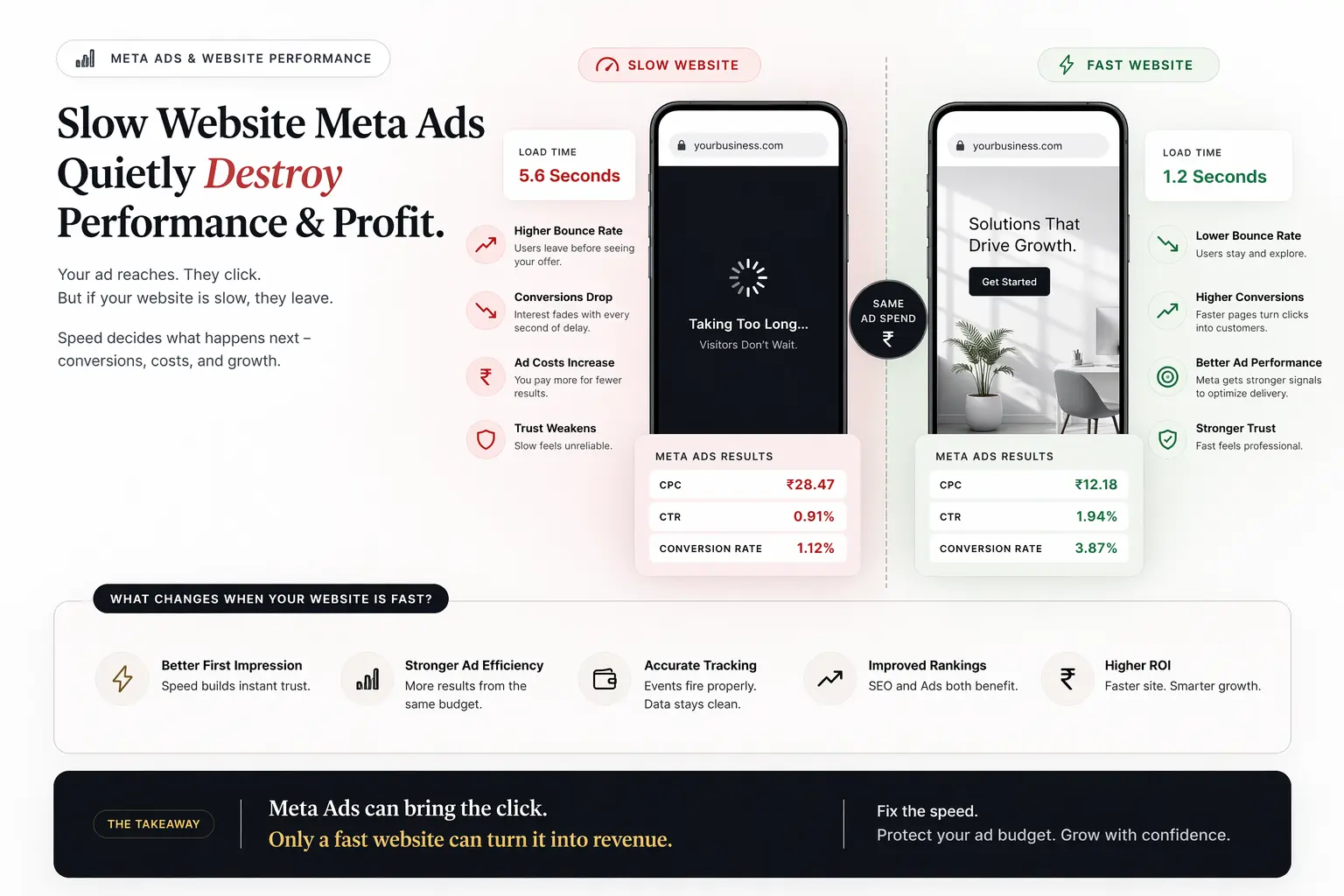
This disconnect becomes sharper when you compare Meta traffic with faster direct or organic sessions. The same offer, the same brand, and similar intent — but the slow Meta landing setup produces lower conversion, weaker engagement depth, and noisier attribution.
How Speed Shapes User Psychology During Paid Traffic
The psychological impact of slow Website Meta Ads journeys is often underestimated. Your audience does not consciously say, “this page is 4.8 seconds slower than I prefer.” Instead, they experience micro-frustrations that quietly reduce openness, exploration, and willingness to commit.
When a page loads fast, the brain receives a subtle signal of competence. The user feels in control, their intent is respected, and they are more willing to read, scroll, and respond. When a page drags, cognitive friction appears before your content has a chance to make its case.
Over thousands of paid sessions, this psychological pattern compounds. A fast, stable experience increases the probability that users read pricing, FAQs, testimonials, and guarantees — the very elements your sales team knows are necessary for confident decisions.
Practical frame: you are not paying Meta for “clicks.” You are paying for micro-moments of attention and openness. A slow website converts those moments into frustration before your proposition is even visible.
Why Meta Algorithm Performance Suffers When Websites Are Slow
Meta relies on conversion events to understand who finds your offer valuable, which creatives produce strong signals, and where to find similar people. Slow Website Meta Ads journeys disrupt this feedback loop in three ways: delayed events, missing events, and corrupted learning.
When pages are slow, some users drop before the pixel or Conversions API can fire complete events. Others experience broken or partial tracking as scripts compete for resources on overloaded layouts. The algorithm then sees fewer conversions than reality, concluding that your ad sets, audiences, or creatives are weaker than they truly are.
Over time, Meta shifts delivery away from segments that were quietly converting but under-reported. Budget flows to easier clicks, not better customers, and your slow website cost Meta Ads performance in a way that is difficult to diagnose from topline metrics alone.
For a more objective performance review, test your live landing pages with Google PageSpeed Insights before assuming the campaign itself is the problem.
Slow Website vs Strong Website for Meta Ads
To make the impact tangible for leadership teams, it helps to compare a slow Website Meta Ads experience with a structurally strong one. The difference is not only in aesthetics, but in financial and strategic control.
| Dimension | Slow Website with Meta Ads | Strong, Fast Website with Meta Ads |
|---|---|---|
| First impression | Delayed load, layout shifts, subtle sense of friction and doubt. | Immediate visibility, stable layout, sense of competence and clarity. |
| Attention capture | Users spend mental energy waiting rather than understanding the offer. | Attention flows directly into your headline, proof, and primary CTA. |
| Conversion rate | High drop-off before forms, carts, or booking flows are usable. | Higher completion rates with fewer steps abandoned mid-process. |
| Meta learning quality | Partial or delayed events; algorithm sees weaker or noisier signals. | Clean, consistent events; algorithm reliably learns who converts best. |
| Cost structure | Effective CPC and CPA inflated by silent wastage and missed revenue. | Media budget converts more clicks into measurable, profitable outcomes. |
| Trust formation | Experience feels under-engineered; sensitive categories lose credibility. | Experience feels intentional and prepared; trust accelerates faster. |
| Scaling readiness | Scaling amplifies inefficiencies; more spend, same underlying leak. | Scaling multiplies profitable behaviour with stable unit economics. |
| Leadership visibility | Reports show inconsistent data, leaving strategy debates unresolved. | Clear view of which campaigns, audiences, and journeys truly create value. |
For founders and marketing leaders, this comparison reframes speed from “nice to have” into a board-level growth lever. It also defines why website development quality and ad strategy cannot be separated in serious organisations.
How Website Development Quality Changes Meta Ad ROI
A well-built site is not just visually polished; it is structurally designed for performance, tracking, and scale. When website development quality is weak, even a sophisticated media plan cannot compensate for the friction created at the point of conversion.
Businesses that treat landing page builds as a low-cost, one-time project often discover later that their slow website cost Meta Ads every single month. The gap appears as rising CPA, flat revenue despite higher spend, and inconsistent reporting between ad platforms and internal numbers.
A more strategic approach connects website development services with paid media architecture from day one. Layouts, content sequence, tracking architecture, and performance budgets are designed around real acquisition flows — not just aesthetics.
When leaders want to understand investment levels, resources like a transparent view of website development cost in India help anchor the discussion. The critical insight is this: the cost of not investing in speed and structural quality often exceeds the cost of doing it properly by a very wide margin once paid media is active.
Why Tracking Becomes Unreliable on Slow Websites
Slow Website Meta Ads issues are not only about users leaving early; they also compromise the integrity of your analytics. Heavy scripts, mis-ordered tags, and delayed loads often mean that key events fire too late or not at all, especially on mobile and mid-range devices.
When tags are competing for limited performance budget, some events time out before completion. Scroll depth, click tracking, form submissions, and even purchases can appear in your backend but never be sent back to Meta or your analytics systems with full fidelity.
This leads to a deceptive picture: Meta under-reports conversions; your CRM or sales team sees more deals; leadership questions both numbers. The root cause is not only “attribution noise,” but slow, overly complicated pages that never gave tracking scripts a fair chance to execute.
For serious organisations, aligning Meta Ads with robust analytics and conversion tracking is not optional. Partnering with specialists in analytics and conversion tracking services ensures that your data layer, tags, and performance profile are engineered to work together, not against each other.
What Serious Businesses Should Fix Before Increasing Ad Budgets
When leaders feel tempted to “test with more budget” on underperforming campaigns, it is worth pausing. If slow Website Meta Ads issues remain unresolved, scaling primarily accelerates inefficiency. The decision sequence matters more than the spend level.
1. Establish a Speed Baseline
Begin by measuring real-world mobile performance rather than relying on desktop tests. Analyse time to first meaningful paint, time to interactive, and how quickly your primary CTA becomes usable. Your threshold is simple: would you personally wait through this experience if you had just clicked an ad between two other tasks?
2. Simplify and Prioritise the Landing Experience
Remove unnecessary scripts, heavy third-party widgets, and non-essential visual effects that add weight without adding conversion power. Prioritise clean hero content, social proof, and a direct call to action. Every unnecessary request is a small tax on user patience.
3. Align Website Build with Meta Strategy
Your development choices should reflect the acquisition path you are buying through Meta. If your core goal is lead generation, design for fast, distraction-free form or WhatsApp flows. If it is purchase, optimise product discovery and checkout clarity rather than decorative elements.
4. Re-architect Tracking on a Faster Foundation
Once performance is under control, revalidate your event hierarchy, parameters, and deduplication between pixel and server-side events. This is where working with teams experienced in both media and data — not just one side — becomes decisive.
5. Scale Only After Confidence
With speed, conversion paths, and tracking aligned, your Meta Ads budget can finally operate as an intentional growth lever. Scaling then multiplies a proven unit economics model instead of amplifying unmeasured risk.
For companies that prefer a single accountable partner, integrated digital marketing services or a deeper digital growth partner relationship create one strategy, one architecture, and one source of truth across website, tracking, and Meta Ads.
Ready to Turn Slow Website Meta Ads into a Fast, Measurable Growth Engine?
If your brand is investing in Meta Ads while your website still feels slow, unstable, or difficult to measure, you are carrying hidden cost in every campaign. MyProHub works with founders and leadership teams to align website performance, tracking architecture, and Meta strategy into a single growth system.
We combine premium website development, signal-focused analytics, and Meta Ads execution so your budget funds outcomes, not friction. The objective is simple: faster pages, clearer data, and higher-quality conversions that compound month after month.
FAQ: Slow Website Meta Ads
How does a slow website affect Meta Ads performance?
A slow website affecting Meta Ads leads to higher bounce rates before users see your offer, fewer tracked conversions, and weaker algorithm learning. As a result, your campaigns appear less effective than they really are and your cost per acquisition quietly rises.
Can a fast website really reduce Meta Ads cost?
Yes. When landing page speed Meta Ads journeys load quickly, more users stay to engage, more conversions are accurately tracked, and Meta can find similar high-quality users. This combination improves effective CPC and CPA over time, even if bid levels remain the same.
Is creative still important if speed is fixed?
Creative remains critical, but it should be optimised after foundational issues like website speed and tracking are stabilised. Without that base, creative testing produces noisy conclusions because you cannot isolate whether performance shifts are due to message, audience, or technical friction.
How fast should a Meta Ads landing page be?
As a practical benchmark, your Meta landing pages should become meaningfully usable on mobile within a few seconds, with the core headline and primary CTA visible and interactive quickly. Page experience guidance from platforms like Google emphasizes similar principles for user satisfaction and conversions.
What is the best way to start fixing slow Website Meta Ads issues?
Start by measuring real mobile performance, then streamline your landing page, optimise critical assets, and rebuild your tracking on top of that faster foundation. If you prefer expert support, partnering with a Meta-focused team that also understands development and analytics ensures the fixes work together rather than in isolation.