

Why Your Website Gets Visitors But No Enquiries (And How To Fix It)
Why your website gets visitors but no enquiries is one of the most common problems businesses face when traffic grows but conversions stay weak.
Search engines, ads, and social media bring people in. The website decides whether they become leads. That is why understanding why your website gets visitors but no enquiries is fundamentally a conversion problem, not a traffic problem.
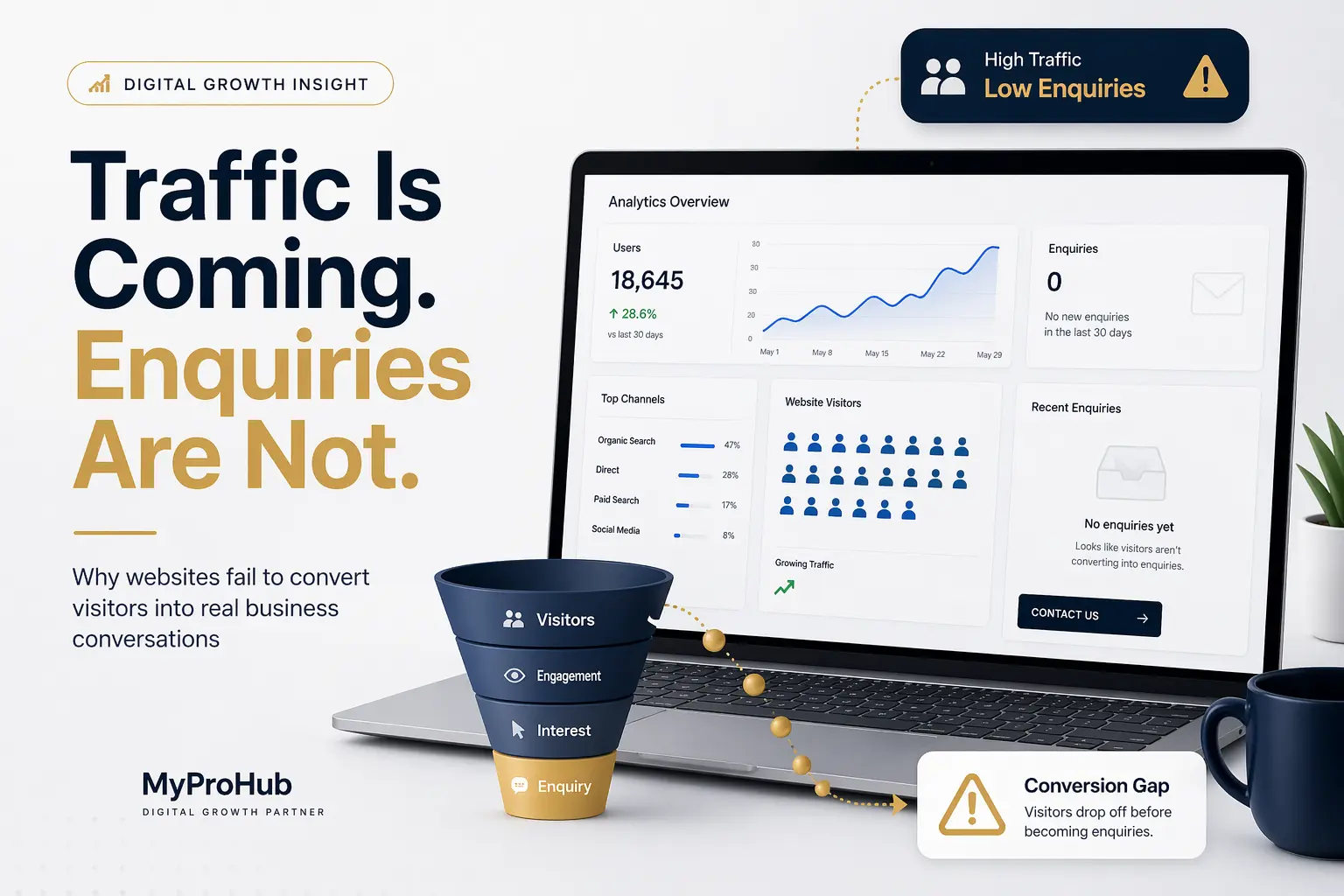
Visibility is not the same as demand
Many owners see healthy analytics numbers and still ask, almost frustrated: “Why your website gets visitors but no enquiries when people are clearly visiting?” It feels confusing, because we are conditioned to believe more traffic automatically means more business.
In reality, website traffic but no leads usually means one thing: your site is not built to convert the kind of visitors you are attracting. There is a gap between who is landing, what they see, and what they are asked to do next.
This article unpacks seven real reasons serious businesses face website conversion problems, and how to fix each in a practical way—without jargon, guesswork, or gimmicks.
Why Your Website Gets Visitors But No Enquiries Even With Good Traffic
When analytics look healthy but the enquiry inbox stays quiet, the issue is rarely “bad marketing”. Very often, why your website gets visitors but no enquiries comes down to misalignment—between visitor intent, page structure, trust, and calls-to-action.
Businesses naturally ask why your website gets visitors but no enquiries when numbers look good on dashboards. The answer is almost always in the quality of post-click experience, not the volume of clicks.
1. Wrong visitor intent: traffic that was never going to enquire
One of the most common reasons for traffic but no conversions is simple: the people reaching your website are not in a buying or enquiry mindset at all. They may be researching, comparing, or just browsing.
This often happens when SEO or campaigns are built around broad, low-intent keywords such as “best ideas for…”, “examples of…”, or generic informational content rather than “service + city”, “consultation”, “pricing”, or “agency near me”.
In that situation, the website is doing its job for awareness, but not for lead generation. You are measuring the wrong success metric for the type of traffic you built.
How to fix wrong intent
- Review your top landing pages and search terms. Separate informational traffic from high-intent traffic.
- Create dedicated enquiry-focused pages for “ready to act” visitors with clear offers, forms, and contact options.
- Align SEO efforts with business intent. If you are investing in organic growth, map real sales keywords before chasing volume. For deeper planning, you can explore structured breakdowns such as SEO cost in India to understand the relationship between investment, intent, and outcomes.
2. Weak trust signals: people see you, but do not believe you
Many sites look “presentable” but do not feel safe, real, or proven. In that first 3–5 seconds, visitors subconsciously ask: “Can I trust this business with my time, money, or data?”
When there are no strong trust markers, serious buyers decide to postpone, research more, or choose a competitor that feels more established. The result: website traffic but no leads even though the design looks “fine”.
Signals that quietly kill enquiries
- No real client testimonials, reviews, or human names.
- No case studies showing before/after or actual business outcomes.
- Generic stock photos instead of your team, premises, or real work.
- No visible address, local presence, or business identity details.
How to fix trust on your website
- Add specific testimonials with names, roles, and outcomes, not just “Great service!”
- Show 2–3 focused case stories with context, challenge, and measurable improvement; if you need a reference format, see structured examples like MyProHub case studies.
- Include clear company information—city, registration details where relevant, and easy contact methods.
- Place trust elements near CTAs, not buried at the bottom of a long page.
3. Poor CTA placement: no guided next step, no enquiry
Many owners underestimate how much visitors rely on clear guidance. When there is no visible, relevant call-to-action (CTA), the default behaviour is to read, scroll, think “interesting” – and close the tab.
In conversion terms, this is one of the simplest website conversion problems to fix: the site is informative but not directive.
Typical CTA issues
- Primary CTA only at the bottom of the page, not above the fold.
- Multiple weak CTAs (“Learn more”, “Explore”) instead of one strong action.
- Same CTA for all visitors, regardless of their stage (first-time vs ready-to-buy).
- CTA design merges with the rest of the layout—no visual hierarchy.
How to fix CTA structure
- Define one main action you want from high-intent visitors (e.g., “Schedule a consultation”, “Request pricing”, “Talk to an expert”).
- Place that CTA above the fold on key pages, and repeat it naturally through the content.
- On mobile, use sticky call or WhatsApp buttons for faster response, especially in India where many enquiries start on messaging apps.
- Use supportive microcopy near CTAs: “No payment now, just a quick discussion” or “Get a structured quote within 24 hours”.
4. Slow mobile experience: people leave before they can even decide
In many Indian and global markets, the majority of visitors now come from mobile devices. That means your site is not just a design asset—it is a speed and friction test.
Slow pages, heavy sliders, pop-ups, and complex scripts cause silent bleed. Visitors never become enquiries because they never fully load the page or reach your form.
Mobile signals that cause drop-offs
- Pages taking more than 3–4 seconds to load on 4G or average Wi‑Fi.
- Large hero images, autoplay videos, and uncompressed media.
- Forms that are difficult to fill on smaller screens.
- Buttons placed too close together, causing tapping errors.
How to fix mobile experience
- Test your website on a real mid-range Android device, not just on a fast laptop.
- Compress images, remove unnecessary animations, and simplify above-the-fold content.
- Keep forms short on mobile: name, phone/email, and one key qualifier.
- Make primary CTAs thumb-friendly with enough spacing and clear contrast.
5. Weak landing page structure: information without decision design
Some websites look good at a glance but are not designed as landing pages. They read like brochures—sections loosely arranged, benefits scattered, no clear hierarchy of what matters first.
This is another quiet driver of why your website gets visitors but no enquiries. People cannot quickly answer three basic questions: “Is this for me?”, “Do they understand my problem?”, and “What happens if I contact them?”
Elements of a strong enquiry-focused page
- A clear, specific headline: what you do, for whom, and in which geography or segment.
- A concise subheading that explains the core outcome you enable.
- Visible proof: logos, results, or outcomes from real clients.
- Structured benefits, not features—tied to business realities like revenue, admissions, bookings, or appointments.
- A simple, trustworthy enquiry form or contact path.
How to fix page structure
- Rewrite your hero section to speak directly to your best-fit customer segment.
- Move proof (testimonials, logos, case metrics) higher on the page.
- Remove sections that distract from the main enquiry path.
- If you are planning a fresh build or redesign, review frameworks and budgeting logic like website development cost in India to align design decisions with conversion goals, not just aesthetics.
6. No analytics clarity: you are flying blind on what actually works
Many businesses look at pageviews and sessions but do not track which sources, pages, and actions actually lead to qualified conversations. This is why website not generating enquiries often feels like a mystery.
Without proper conversion tracking, you cannot see the difference between visitors who skim and leave, and visitors who seriously explore, compare, and enquire.
Common analytics gaps
- No defined goals for form submissions, calls, or WhatsApp clicks.
- No separation between branded and non-branded search traffic.
- No tracking for micro-actions like time on key pages, scroll depth, or pricing page visits.
- No connection between website data and CRM or enquiry logs.
How to fix analytics for conversion clarity
- Set up clear goals or events for every enquiry path (forms, calls, chat, WhatsApp).
- Tag campaigns correctly in Google Ads, Meta Ads, and email so you know exactly which source generated which enquiry.
- Compare analytics conversions with real leads in your CRM or simple spreadsheet each month.
- Reduce the number of “vanity metrics” you look at. Focus on qualified enquiries and real revenue influence.
7. Messaging mismatch between ads, SEO, and website
A frequent source of website conversion problems is the disconnect between what people see in your ad or search snippet and what they see on the landing page.
If the ad promises one thing, the search result suggests another, and the website talks about something else, visitors experience friction. They feel “sold to”, not supported.
Where mismatch usually appears
- Google Ads offering a strong outcome, while the landing page repeats generic company copy.
- Meta Ads pushing urgency or discounts, but the website feels slow and neutral.
- SEO pages written for keywords, but not for the actual human context behind them.
How to fix messaging alignment
- Ensure the main phrase or promise in your ad appears clearly on the landing page.
- Align tone: if your ad is direct and outcome-focused, your page should not feel vague or corporate.
- Map key campaigns to focused pages instead of sending everything to the homepage.
- If you are already investing in paid media, see how offer, copy, and tracking alignment works in practice; frameworks like why Google Ads fail even with good budget or Meta Ads cost in India show how campaigns and websites must speak the same language.
Why traffic alone is misleading without conversion structure
Traffic is a visibility metric. Enquiries are a behaviour metric. Revenue is a business metric. When you only look at the first, it is easy to misjudge the health of your digital presence.
A website can cross thousands of visits a month and still underperform because it lacks a conversion structure: clear journey, trust, CTAs, speed, and analytics. The right question is not “how do I get more visitors?” but “how do I help the right visitors make a confident decision?”
How serious businesses think about websites
Serious businesses do not see their website as a brochure or a design project. They see it as a controlled environment where strangers turn into qualified conversations.
They know that website traffic but no leads is not solved by more campaigns alone. It is solved by treating the site as part of a connected growth system—where SEO, paid media, on-site behaviour, and analytics all support the same conversion logic.
At MyProHub, this is exactly how we think about digital structure. We focus on connected growth systems where search, ads, website, and data are not separate vendors, but one aligned engine. That is how we help both local and global businesses turn attention into predictable enquiries, not just fluctuating visitors.
Practical audit: where to start if your website gets visitors but no enquiries
If you are already facing traffic but no conversions, it helps to run a simple, structured audit instead of guessing.
Quick audit sequence
- Step 1 – Intent check: List your top 10 keywords and landing pages. Mark which ones are research intent vs. enquiry intent.
- Step 2 – Trust check: On each key page, count visible proof elements above and near the CTAs.
- Step 3 – CTA check: Confirm every important page has a clear, single main action, visible without scrolling.
- Step 4 – Mobile check: Open your site on a normal phone over mobile data. Time how long it takes until the page feels usable.
- Step 5 – Analytics check: See if every enquiry path is actually tracked as a goal or event.
- Step 6 – Message alignment: Compare 3–5 main ads or search snippets with their landing pages. Check if the promise matches the page.
You do not need advanced tools to see patterns. Even a basic pass with this checklist often shows exactly why your website gets visitors but no enquiries even though your ads or SEO seem active.
If you want external support, look for a partner that does not treat traffic, website, and analytics as separate. Integrated teams—like those offering full-stack digital marketing services in India tied to measurable outcomes—tend to solve the full chain instead of just “fixing the website header”.
From visitors to serious enquiries, by design
At MyProHub, we focus on connected systems where SEO, paid ads, website behaviour, and analytics are built to support one clear goal: better quality enquiries, not just more traffic.
Businesses often assume more traffic will solve growth. In reality, enquiries improve when your digital structure supports decision-making.
FAQ: website traffic but no leads
Why does my website get visitors but no enquiries?
Because visibility alone does not create intent or trust. In most cases, there is a mismatch between visitor intent, page structure, trust signals, and clear calls-to-action—so people leave without taking the next step.
Is my traffic bad if I get no leads?
Not necessarily. Some of your traffic may be high-intent, but your website may not be built for conversion. The first step is to separate informational visitors from those who are ready to enquire, then improve the experience for the second group.
How do I know if my website has conversion problems?
You likely have website conversion problems if you get steady visitors from branded search, local keywords, or paid campaigns, but enquiry volumes are irregular or very low. Running a simple audit on CTAs, trust, mobile speed, and analytics usually reveals the gaps.
Will more traffic automatically fix my enquiry problem?
No. Sending more visitors into a weak conversion structure usually increases cost without improving results. Enquiries improve when your digital structure helps people understand, trust, and act—then scaling traffic starts to make sense.
Internal growth reading
If you want to go deeper into connected growth systems beyond “more traffic”, you can explore:
- SEO Cost in India – to understand how structured organic investment supports long-term enquiry flow.
- Website Development Cost in India – to plan websites as conversion assets, not just design projects.
- Why Google Ads Fail Even With Good Budget – to see how campaigns and websites must work together.
- Meta Ads Cost in India – to align paid social spend with conversion expectations, not just impressions.
- MyProHub Case Studies – for structured examples of how integrated systems change enquiry quality.
- Digital Marketing Services in India – if you prefer a unified team for SEO, ads, and conversion-focused websites.
All of these resources are built around one simple idea: traffic is only useful when your digital structure supports real decision-making. Businesses often assume more visitors will fix weak results. In practice, enquiries improve when your website is designed to convert the right traffic you already have.