

SEO vs Google Ads for Small Business: A Calm Growth Decision
Small businesses often compare SEO and Google Ads as if one must replace the other. In reality, they solve different business pressures at different speeds.
SEO builds long-term visibility. Google Ads buys immediate intent. The smarter question is not seo or google ads for small business in absolute terms, but which mix your current stage can fund, execute, and sustain.
What SEO and Google Ads actually solve
SEO and Google Ads are not enemies. They are tools for solving different timing problems inside the same growth system.
SEO compounds brand visibility in organic search. It turns content, structure, and authority into an asset that continues to drive discovery long after a specific campaign is over. A small business SEO strategy is essentially an investment in being found consistently by the right people without paying per click.
Google Ads, by contrast, is a precision engine for paid visibility. It lets you buy specific queries, locations, and moments of intent today, test offers quickly, and dial budget up or down with control. Google ads for small business growth is about speed, testing, and controlled demand generation.
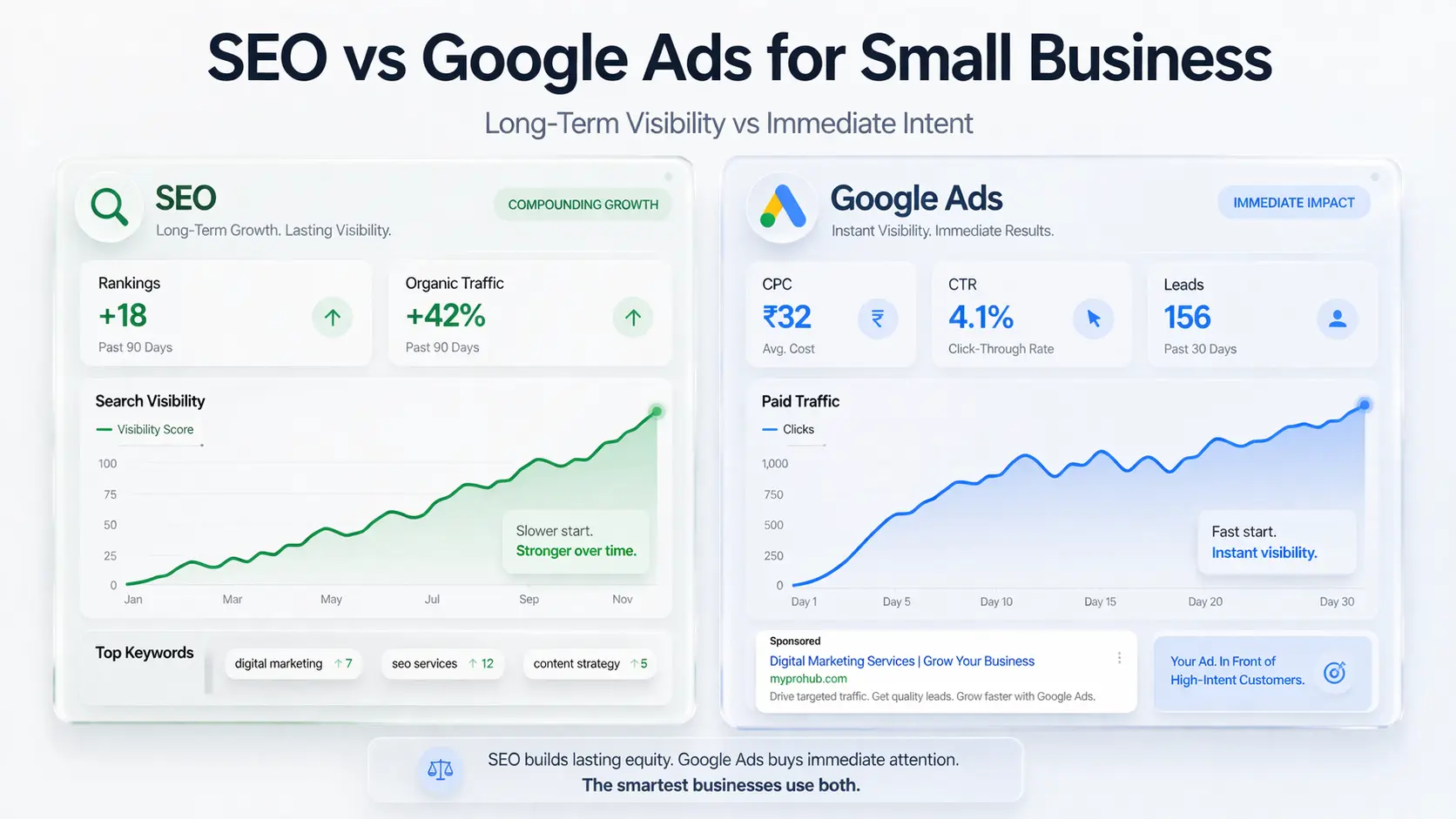
SEO: slower start, stronger long-term asset
SEO is infrastructure. You do not switch it on and see leads in 24 hours. You design it, build it, and then benefit from it repeatedly once it is in place.
For small businesses, this means a simple trade-off: SEO usually takes months to shape meaningful rankings, but once those rankings stabilise, traffic and leads continue even on days when you are not actively “spending”. That is why seo vs paid ads small business conversations often tilt toward SEO for long-term cost efficiency.
In practice, strong SEO for a small business looks like this: clear service pages, structured topic clusters, internal links, local signals, and content that answers real buying questions. You can see this philosophy in how MyProHub designs structured SEO systems — not as random blogs, but as a calm, interconnected asset.
Insight: SEO is less about “getting on page one” and more about building a search asset that matches how your best customers think, search, and decide.
Google Ads: faster signals, immediate visibility
Google Ads is the opposite in timing. You can switch it on, define your budget, and be visible within hours for your target keywords.
This speed matters when your pipeline needs help now. Launching a new offer, entering a new city, or validating whether a positioning resonates — all of these lean on paid search for fast, directional answers.
The trade-off is straightforward: you pay for every click. When spend pauses, so does the traffic. That is why google ads or seo which is better is not a useful question on its own. The better question is: what timeframe are you optimising for, and what can your cash flow support?
Simple filter: if your business genuinely needs qualified leads this month, SEO alone is usually too slow. Google Ads becomes part of the conversation.
Cost difference over time
Cost profiles are where SEO vs Google Ads for small business often gets misunderstood. Both require investment. They simply pay back differently over time.
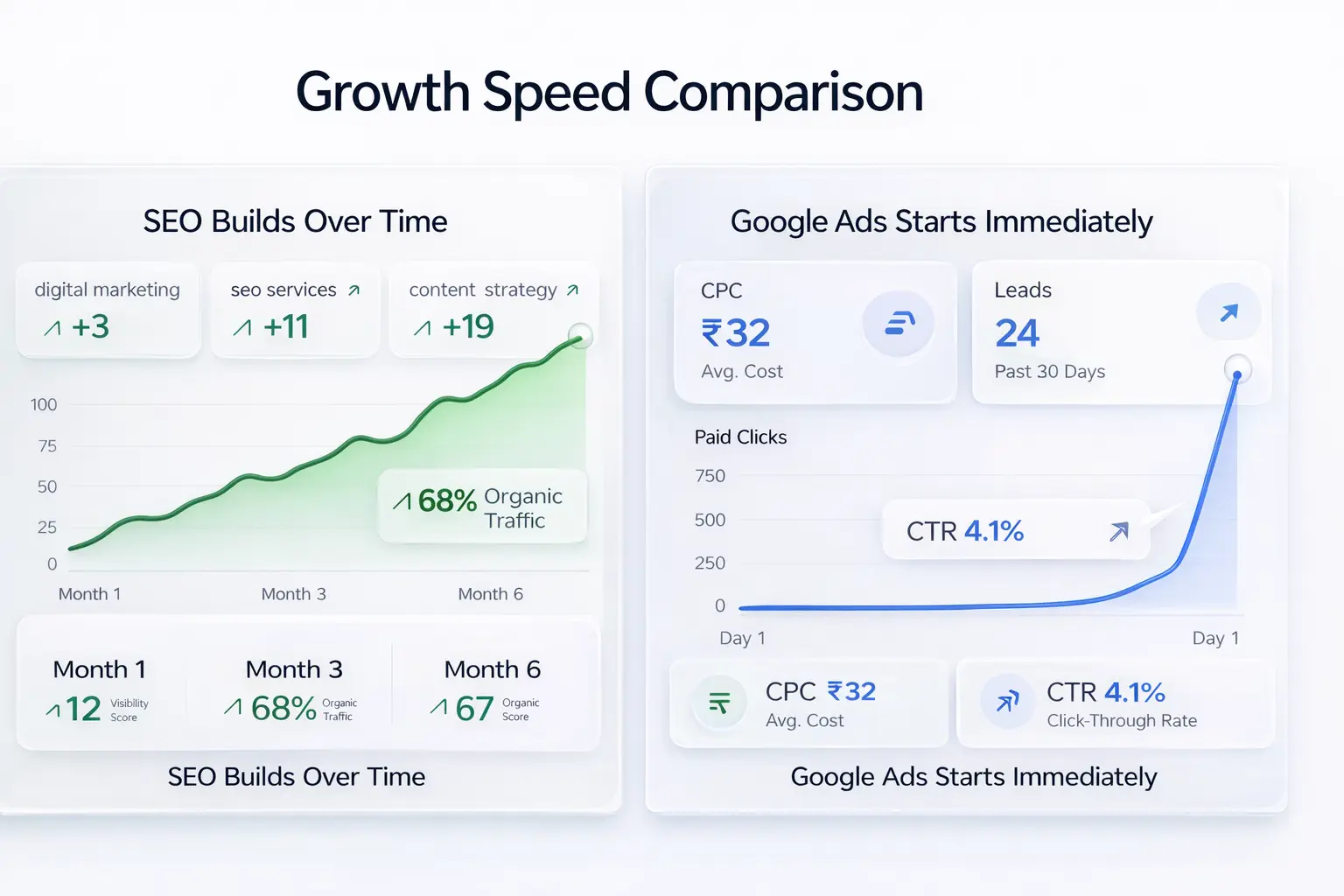
SEO typically starts as a fixed monthly or project-based investment — strategy, content, technical work. In the first few months, cost per lead can feel high because rankings and trust are still forming. Over 6–12 months, as more pages start performing, your effective cost per lead usually drops.
Paid search, on the other hand, is linear. You pay for each click, every month. In competitive industries, CPC can rise year over year, which is why understanding Google Ad cost in India and your target economics is crucial before scaling.
| Factor | SEO | Google Ads |
|---|---|---|
| Time to first meaningful results | 3–6 months for most small businesses | 24–72 hours once campaigns go live |
| Cost per click | No CPC; investment in expertise and content | Paid per click, influenced by competition |
| Cost per lead trend | Decreases as rankings and content deepen | Flat or increasing with industry CPC pressure |
| Traffic if you pause spend | Continues, then slowly decays | Stops almost immediately |
From a finance perspective, SEO behaves like capex with ongoing optimisation. Google Ads behaves like opex that you can flex but not escape. A balanced decision recognises both.
Lead quality differences
Not all leads are equal. A quiet but important part of seo vs google ads for small business discussions is lead quality — not just volume.
Organic leads often feel “warmer” because they discovered you through research, comparisons, and content. They may have read a guide, a service page, or a case study before reaching out. Paid leads can be just as strong, but they often require clearer qualification because some users click out of curiosity or habit.
Well-structured small business SEO strategy and well-built Google Ads both produce excellent leads. The difference comes from how closely search intent, ad message or meta title, landing page, and sales conversation are aligned.
| Aspect | SEO | Google Ads |
|---|---|---|
| Discovery path | Research-driven, content-led | Ad-driven, intent-led |
| Typical mindset | Comparing options, seeking depth | Ready to act, but needs clarity |
| Trust signal | High — organic often perceived as earned | Medium — marked as sponsored, still effective |
| Sales conversation | More context, longer research trail | More direct, may need more education |
Operational insight: what your sales team says about lead quality is as important as what your analytics dashboard says about cost.
When SEO becomes smarter
There are seasons where SEO is the smart primary bet. Usually when your cash flow is stable enough to tolerate a slower build, your market has clear search demand, and you want compounding visibility instead of perpetual ad spend.
For example, expert-led services, local specialists, and B2B firms with considered buying cycles often benefit from investing early in SEO. A well-designed small business SEO strategy makes every future digital action easier — content performs better, email performs better, even your paid campaigns convert better when people also see you organically.
If you want to see how this looks in practice, the SEO case study and SEO services in India pages at MyProHub show how structured organic systems can quietly support multiple channels at once.
When Google Ads becomes necessary
There are also moments where paid search is not optional. If you are launching a new product, entering a new geography, or recovering from a pipeline slowdown, waiting six months for SEO to mature is not realistic.
In those cases, google ads for small business growth provides something SEO cannot: controlled speed. You can switch on campaigns, test messaging, discover which keywords convert, and feed those learnings back into your broader marketing.
Google’s own guidance on SEO vs PPC echoes this balance: use paid for immediate visibility and testing, use SEO for durable, cost-effective presence. The most resilient small businesses learn to do both without confusing them.
Simple filter: if your business will materially suffer without new leads in the next 30–45 days, paid acquisition deserves a serious look alongside whatever you plan for SEO.
Why combining both often wins
When you step back, seo vs google ads for small business is the wrong framing. The more useful lens is sequencing and integration.
Paid campaigns reveal which queries, messages, and offers resonate fastest. Those insights inform your content plan, keyword strategy, and landing page design. As SEO gains traction, organic visibility reduces overall acquisition cost and creates a base of demand that is not entirely dependent on monthly ad spend.
This is how we think about it at MyProHub as a digital growth partner: use Google Ads to create and accelerate momentum; use SEO to hold and expand that momentum in a way that compounds.
Small business mistakes when choosing one blindly
Most problems arise not from choosing SEO or Google Ads, but from choosing either in isolation, without context.
- Picking SEO only, with urgent revenue pressure, then declaring “SEO doesn’t work” after eight weeks.
- Picking only paid ads, never investing in organic assets, and feeling trapped when CPC rises or budgets tighten.
- Running both without analytics discipline, so no one knows which channel truly contributes to qualified pipeline.
- Treating SEO as a checklist and Google Ads as a slot machine, instead of viewing both as parts of one operating model.
Healthy decisions start with data: search volume, CPC ranges, expected conversion rates, and clean tracking. That is why we often align SEO and Google Ads alongside analytics work, as seen in our analytics and conversion tracking services.
Strategic growth thinking for small businesses
For a founder or owner, seo vs paid ads small business is ultimately a capital allocation question. Where does the next ₹1 of marketing spend create the healthiest mix of short-term stability and long-term resilience?
In early stages, that might mean starting with a modest but structured Google Ads program to create immediate signals, while quietly building an SEO foundation that will reduce your cost per lead over time. As organic performance improves, you may gradually tilt budget away from always-on search ads and toward more selective, high-intent or experimental campaigns.
This is the kind of joined-up thinking we bring to combined SEO and Google Ads work at MyProHub. Whether it is a Google Ads case study or a long-term SEO system, the goal is the same: build a growth engine that you understand, trust, and can explain on a single calm page.
Looking beyond “SEO or Google Ads” to a growth system
At MyProHub, SEO and Google Ads are not separate conversations. They sit inside one growth model: how your business creates, captures, and compounds demand over time.
If you are deciding between SEO vs Google Ads for small business right now, the most valuable next step may not be to pick a channel immediately, but to map your timelines, margins, and constraints clearly — then decide how each channel can support that reality.
FAQ: SEO vs Google Ads for small business
SEO vs Google Ads for small business — which should I start with?
If you need leads this month, Google Ads is usually the more realistic first lever. If you have 6–12 months to invest and want compounding visibility, SEO becomes essential. For many serious small businesses, the answer is not “SEO or Google Ads for small business”, but a phased mix — paid search for immediate signals, SEO building quietly in the background.
Is SEO cheaper than Google Ads for small businesses?
In the short term, SEO can feel expensive because results take time and you are not paying per click. Over a longer horizon, SEO often wins on cost per lead because you are no longer paying for every individual visit. Google Ads remains valuable, but costs tend to rise with competition. The balance depends on your market, margins, and patience.
Google Ads or SEO, which is better for testing a new offer?
For fast testing, Google Ads is usually better. You can target specific keywords, run multiple ad messages, and see within days which search terms and angles generate interest. Those learnings can then shape your small business SEO strategy, content topics, and landing pages so that SEO grows in the right direction.
Can I rely only on SEO and skip paid ads completely?
You can, especially in niches with modest competition and stable referral flows. But relying only on SEO can reduce your ability to test quickly or protect pipeline during seasonal dips. For most growth-focused small businesses, a small, well-structured paid component provides useful resilience and insight alongside SEO.
How do I measure which channel is actually working better?
Clean analytics and conversion tracking are non-negotiable. At minimum, you need clear goals in your analytics platform, consistent UTM tagging, and a habit of looking at cost per qualified lead and closed deals by channel. That is why we often pair channel work with proper tracking setups, similar to what we outline in our analytics and conversion tracking services.
Premium conclusion: from “vs” to “and”
SEO vs Google Ads for small business is a tempting headline. It promises a single right answer. In practice, sustainable growth rarely comes from choosing one channel and ignoring everything else.
SEO builds long-term search equity. Google Ads buys immediate, testable intent. One behaves like a compounding asset; the other like a precise, controllable tap. The job of a founder or owner is not to pick a favourite, but to decide how much of each the business can responsibly carry at each stage.
If you treat both as parts of one system — supported by structured SEO, disciplined paid search, and honest analytics — the question “google ads or seo which is better” becomes far less stressful. It turns into a calm, recurring decision about timing, cash flow, and momentum. That is the kind of decision-making we aim to support at MyProHub when we act as a structured digital growth partner for small and growing businesses.