

7 Structured SEO Systems for Long-Term Growth
Most SEO fails not because “SEO doesn’t work”, but because it is random. If you want durable organic growth, you need structured SEO systems: technical foundations, structured content, and internal links that work together.
Rankings are a moment. Structured SEO systems create momentum.
Why structured SEO systems matter now
Search engines have become more selective. They now reward clear site structure, relevance, authority, and experience instead of shallow keyword repetition or isolated blog posts.
For a business owner, this means SEO is no longer “publish and hope”. It is about designing structured SEO systems where every important page has a purpose, a role in the journey, and a clean path for both users and crawlers.
This is what we call a calm SEO operating model — the opposite of random checklists and one-off tweaks.
1. Random SEO vs systems-based SEO
Random SEO looks like this: someone posts a blog once in a while, adds a few backlinks, changes a title, and waits. When traffic moves, no one knows why. When it drops, no one knows what broke.
Systems-based SEO is calmer. It starts from the business model, maps search intent to specific pages, designs a clear site hierarchy, and uses repeatable processes for technical checks, content, and links. In practice, that means your structured SEO systems can be explained, audited, and improved instead of being a black box.
Simple filter: if you cannot describe your structured SEO systems on one page, you probably have tasks, not a strategy.
| Random SEO | Systems-based SEO |
|---|---|
| Isolated tasks and tools | Joined-up strategy and cadence |
| Content without hierarchy | Topic clusters with clear pillars |
| Focus on “more traffic” | Focus on structured SEO systems and qualified demand |
| Rankings tracked in isolation | Rankings, leads, and authority tracked together |
| Difficult to scale or delegate | Systematised and repeatable |
If you want to see how a service offering reflects this philosophy, explore the SEO Services in India page built around structure, not guesswork.
2. Why rankings alone are not enough
Rankings are visible. Profit is not. This is why so many businesses feel stuck: they chase positions, but not outcomes.
A page can sit on page one and still underperform if it attracts the wrong audience, answers the wrong intent, or sends visitors to a weak offer. Search engines see clicks; your business feels conversions and cashflow.
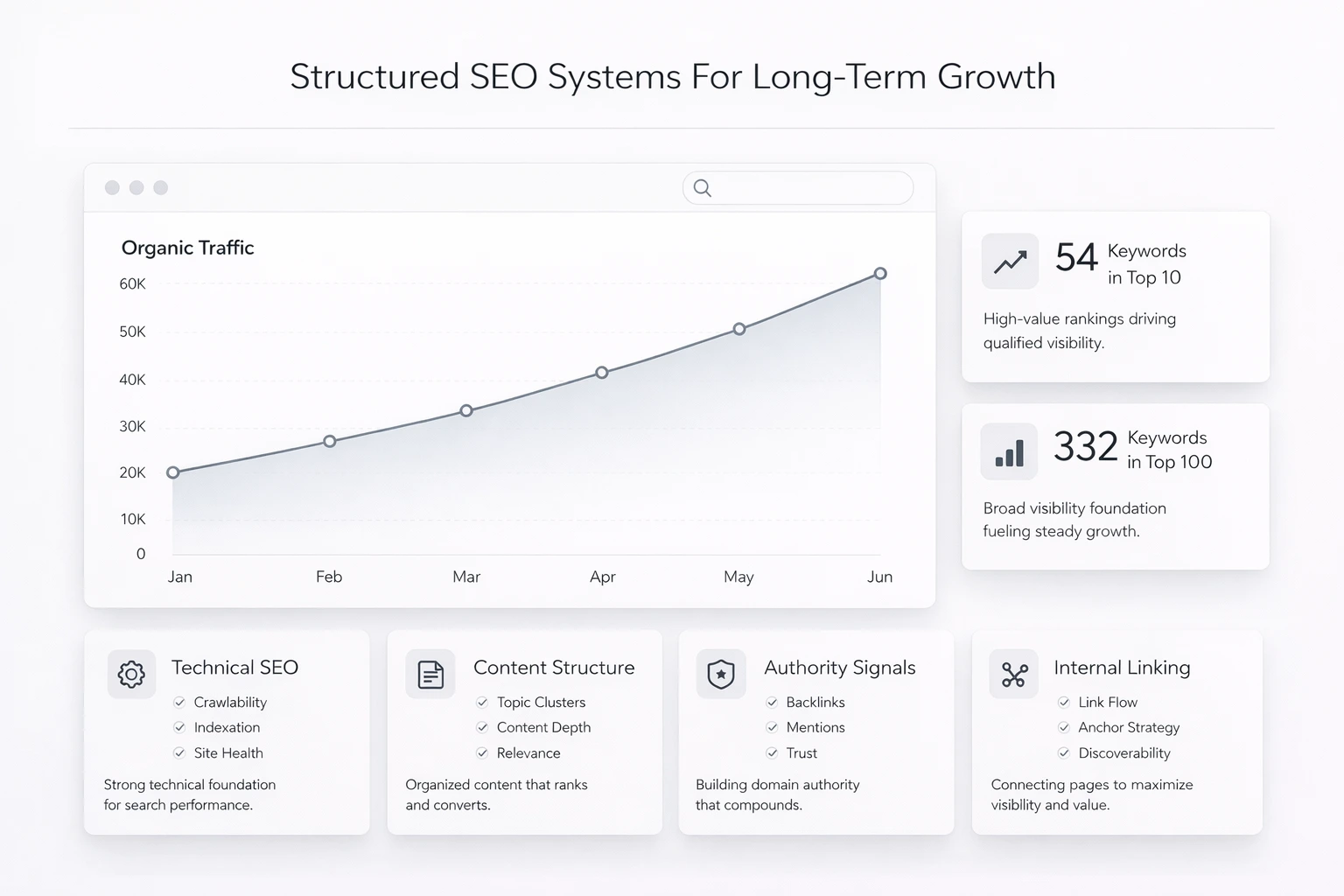
Better question: “Which rankings, within our structured SEO systems, are directly connected to demo requests, sales calls, or purchases?”
3. Technical SEO as infrastructure
Technical SEO is the quiet layer that keeps everything else honest. If crawling is blocked, pages are slow, or signals are inconsistent, even excellent content will struggle.
On a practical level, structured SEO systems need clean indexation, logical URL structure, mobile performance, safe redirects, and a site architecture that search engines can move through without friction.
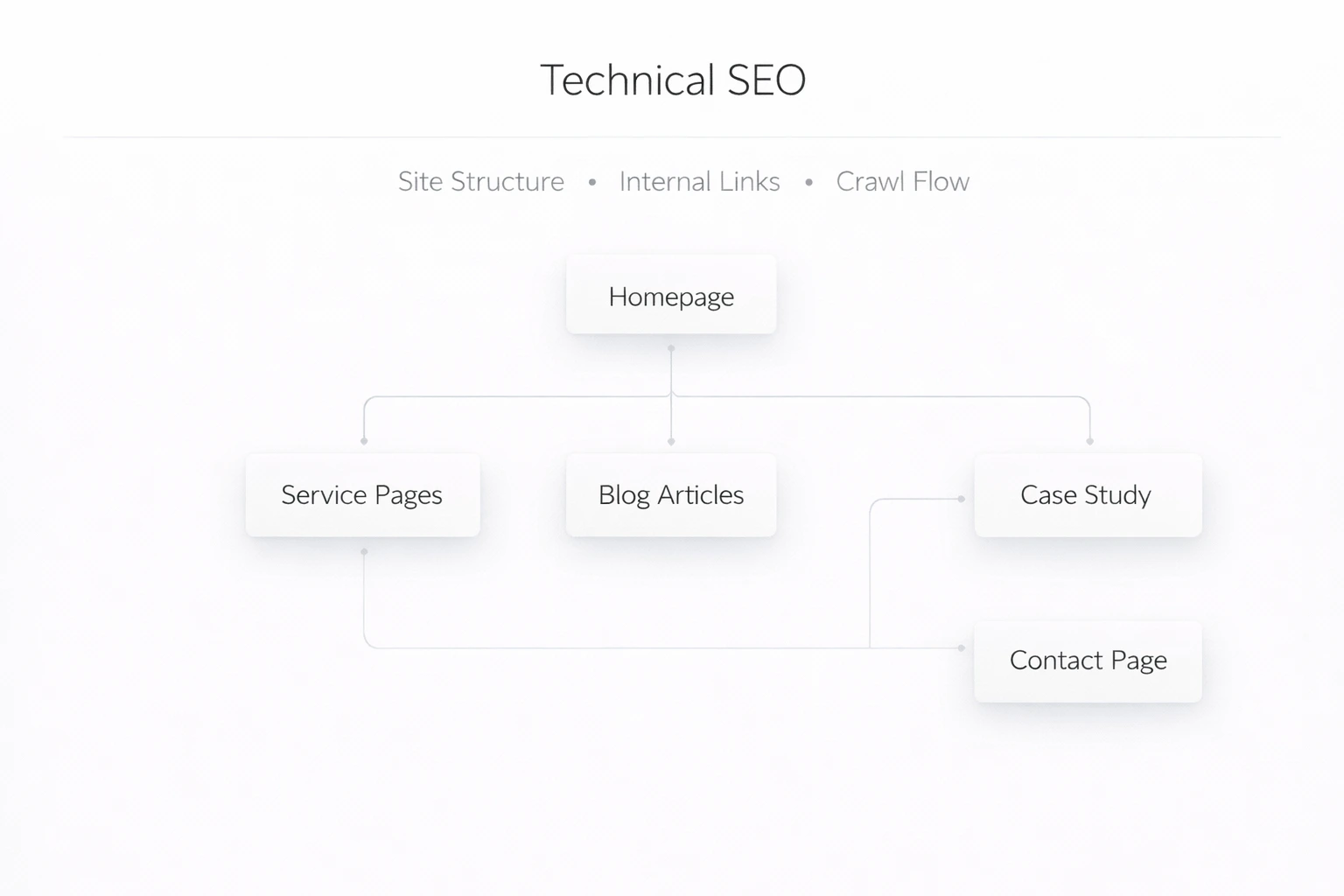
Treat technical SEO like infrastructure. You do not see it every day, but when it is weak, everything else in your structured SEO systems becomes harder.
4. Content structure, not content volume
Most sites do not suffer from “not enough content”. They suffer from “content without structure”. There is a difference.
Structured content starts from pillars: your main services, main problems you solve, and main categories your buyers care about. Around these, you build supporting articles that answer related questions, objections, and comparisons.
Simple test: Can a new visitor understand, in two clicks, what you do, who you serve, and how your structured SEO systems support that journey?
To see how structured proof supports a core offer, review the SEO Case Study alongside the primary service page. This pairing is deliberate: service page for offer, case study for evidence.
5. Authority signals that compound
Search engines look for patterns of trust: depth of content, consistency of topics, external mentions, quality links, and user engagement over time.
Authority is not a hack. It is the result of many aligned signals pointing in the same direction: your site talks like an expert, behaves like an expert, and is referenced like an expert.
- Clear expert pages for core topics.
- Case studies and results that show depth.
- External mentions and links from relevant sites.
- Consistent NAP and brand footprint for local and service businesses.
In other words, structured SEO systems grow authority when your SEO story and your business reality match.
6. Internal linking: the system inside the system
Internal links are how you tell search engines what matters most. They connect your architecture, pass context, and move visitors toward higher-value pages .
For large or growing sites, internal linking is one of the highest-leverage levers you can control. It is also one of the most underused.
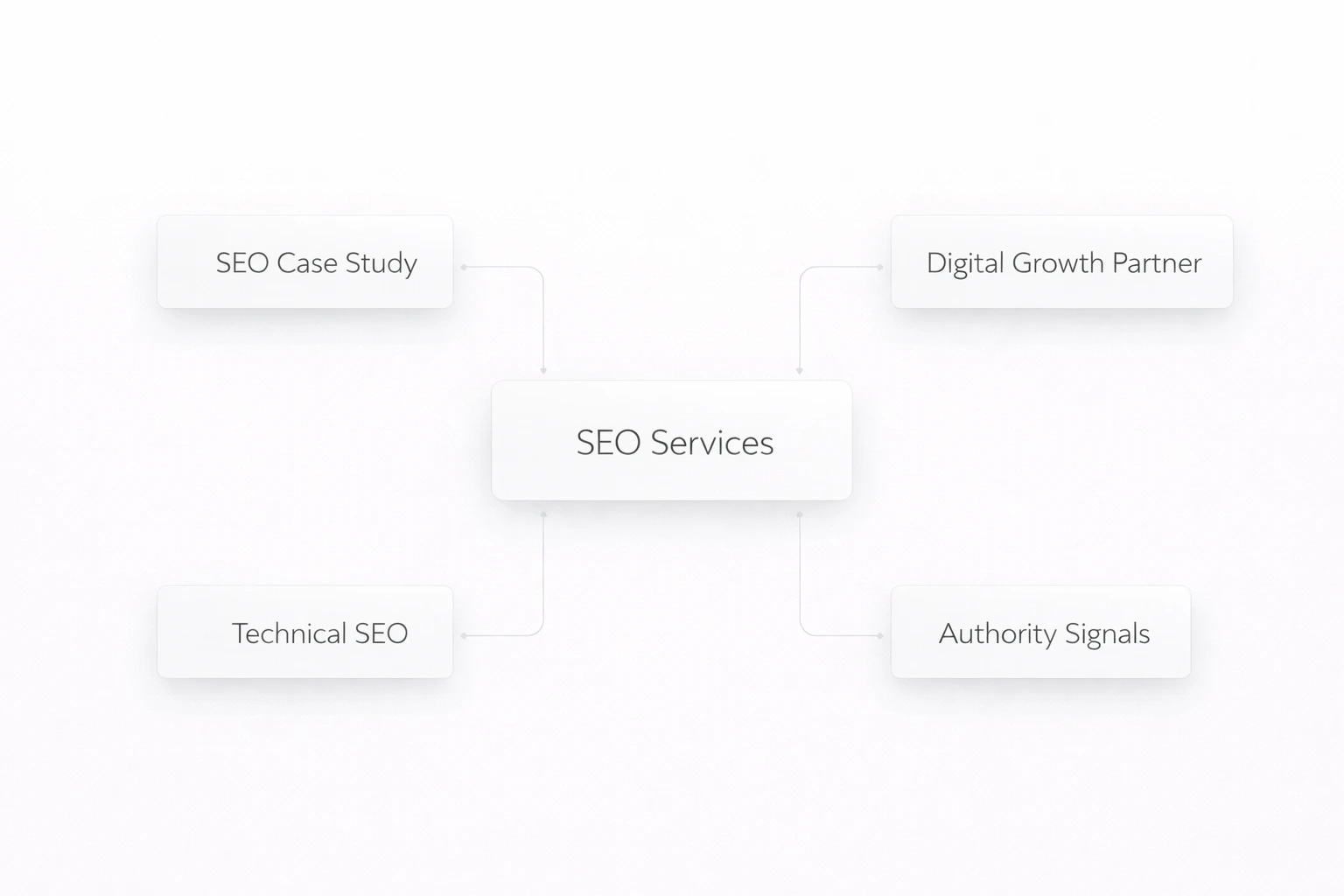
Practical approach: link from education to service, from service to proof, and between related articles that share intent inside your structured SEO systems.
Well-designed internal links help distribute authority efficiently and make it easier for search engines to see your site as a coherent whole rather than separate fragments.
AI Visibility, SEO, AEO and GEO Now Work as One Connected Search System
Traditional SEO still builds discovery, but search visibility is no longer shaped by rankings alone. Increasingly, businesses are being interpreted inside AI-generated environments before users even click a page.
This changes how visibility works. Search engines index pages, while AI systems interpret meaning, trust signals, service clarity, and structured digital presence.
Modern visibility now depends on three connected layers:
SEO for discoverability, AEO for direct answer clarity, and GEO for AI-readable brand interpretation.
When these layers operate separately, visibility becomes fragmented. When they work together, search becomes a stronger business asset.
Why SEO Alone No Longer Explains Full Search Visibility
A page may rank well and still remain absent inside AI-generated answers. This happens because ranking and interpretation are now different layers.
AI systems often prioritize:
- semantic clarity
- direct answer structure
- entity consistency
- topic depth
- authority signals
Pages written only around keyword placement often underperform when answer systems try to extract meaning.
Real Visibility Signals Are Already Emerging
Recent AI search observations already show MyProHub being interpreted through multiple public digital signals, including service pages, business descriptions, founder positioning, and structured authority content.
This matters because AI systems are no longer reading one page. They combine multiple signals before generating summaries.
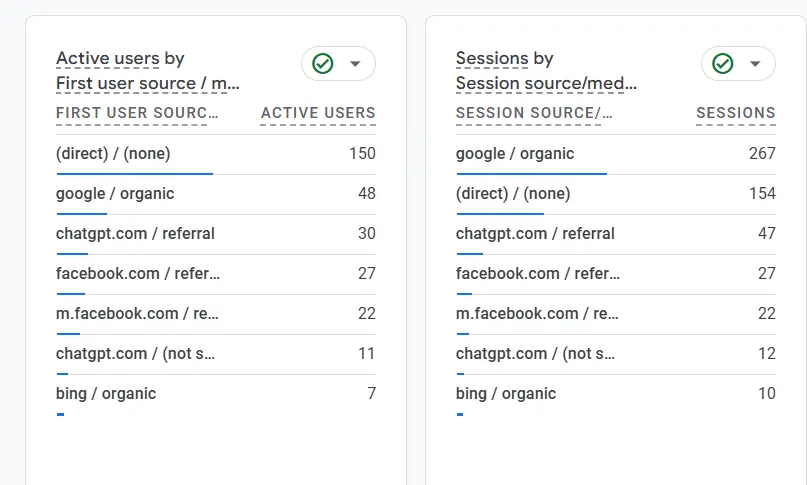
Important signal: AI visibility is no longer theoretical. It is already measurable through referral behaviour.
Why Internal Linking Matters More in Modern Search
Internal linking is no longer only an SEO task. It helps search engines and AI systems understand page relationships, authority hierarchy, and conversion pathways.
Strong internal linking usually follows one simple flow:
- educational article to service page
- service page to proof page
- proof page to enquiry action
For example, businesses exploring structured search growth often move naturally from SEO Services in India to SEO Case Study before evaluating strategic fit.
One Search System Is Stronger Than Separate Tactics
Many businesses still buy SEO, content, and AI visibility as disconnected tasks. That usually creates weak compounding.
At MyProHub, SEO, AEO, and GEO are structured together inside one connected search system so that:
- technical SEO builds clean foundations
- answer-ready content improves extraction
- AI-readable brand structure improves interpretation
- internal links strengthen authority flow
- conversion logic supports business outcomes
MyProHub offers SEO, AEO and GEO in one structured SEO service built for visibility, clarity and conversion.
Why Human Trust Still Decides Conversion
AI may help users discover a business faster, but conversion still depends on human confidence.
Strong search content must do two things together:
- explain clearly
- reduce hesitation
Visibility without trust often produces traffic without enquiry. This is why search systems must be built for both machine understanding and human decision-making.
7. Why structured SEO takes time but compounds
Structured SEO is not slow because it is weak. It is slow because trust, depth, and learning all need time. As your library grows and your signals stabilise, each new page launches into a stronger environment.
This is the compounding effect: early months feel like foundation work, later months feel like momentum. The more disciplined your structured SEO systems, the stronger this compounding becomes.
Healthy expectation: think in quarters, not days. Measure systems, not single posts.
8. When SEO works best for small and mid-sized businesses
SEO works best when your offer is clear, your audience is specific, and your delivery model can actually handle incoming demand.
It is especially effective for local services, expert-led businesses, B2B services, and products with informed buyers who research before they reach out.
In these cases, structured SEO systems can become a reliable base layer: a quiet, compounding channel under your paid campaigns.
9. How structured SEO supports lead generation
SEO for growth-focused businesses should be designed around lead quality, not just traffic volume. That means mapping your buyer journey and aligning content with decision points.
Key intent types that usually produce better leads:
- Service and solution pages (what you do, who you serve).
- Comparison and alternative pages (why you vs another option).
- Case studies and proof assets (what happened for others).
- Deep guides that solve specific, high-intent problems.
When these are connected with clean internal linking and clear CTAs, structured SEO systems turn organic traffic into meaningful pipeline instead of vanity metrics.
10. Common mistakes businesses make before hiring SEO
By the time many companies look for an SEO partner, they have already tried a mix of tactics that never had a chance to work together.
- Publishing blogs without aligning them to services or offers.
- Focusing on a few trophy keywords instead of an intent map.
- Ignoring technical issues that quietly cap performance.
- Underestimating the role of internal linking and site architecture.
- Expecting “fast SEO” in markets where authority still needs to be built.
The pattern is always the same: effort without system. Once structured SEO systems are in place, the same effort starts to produce very different results.
Looking for structured SEO systems, not random tactics?
At MyProHub, SEO is treated as a growth system: technical groundwork, structured content, authority, and internal linking designed to support business metrics, not just rankings.
Businesses looking for structured SEO systems can review service details or contact directly for an audit discussion.
11. FAQ: Structured SEO for business owners
How long does a structured SEO system take to show results?
Most businesses should think in 3–6 month windows for stable traction, depending on competition, current authority, and how complete the technical and content base is.
Is SEO still worth it if I run paid ads?
Yes. Paid ads buy attention quickly; SEO builds an owned asset. Together, they reduce dependency on any single channel and improve blended acquisition costs.
What is the difference between blog content and SEO content?
Blog content can be anything. SEO content is intentionally mapped to search intent, internal linking, and conversion paths so it supports both visibility and leads.
Why is internal linking such a big priority?
Because it shapes how authority and attention move through your site. Strong internal linking helps search engines and users understand which pages are central, and which ones support them.
When should I bring in an SEO partner?
When you want predictable, systemised organic growth and do not want your team guessing which pages, structures, or signals matter most each month.