

Why Your Business Gets Traffic But No Leads
Many businesses confuse visibility with demand. The real issue behind why your business gets traffic but no leads is usually not one problem, but a chain of small conversion leaks across intent, tracking, landing pages, and follow-up. When you recognize why your business gets traffic but no leads at a system level, you can start resolving the specific leaks, not just pushing more visitors into the same gaps.
For brands that want a more structured digital foundation, this also starts with a clear growth stack, and that often includes the right website development services in India to support performance, credibility, and conversion flow.
If you already run campaigns and want a more predictable enquiry system, our structured lead generation services in India help turn scattered traffic into qualified, measurable pipeline.
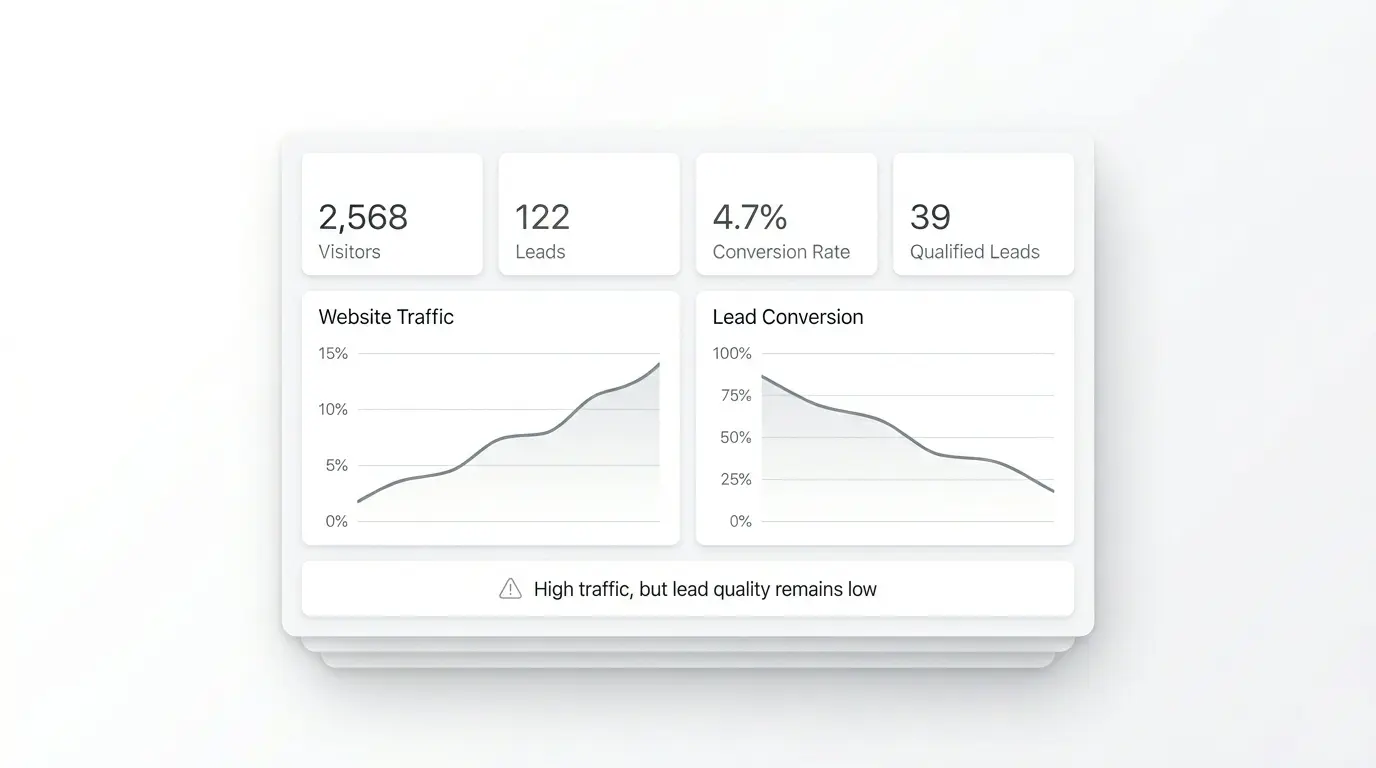
Why Your Business Gets Traffic But No Leads
Traffic creates visibility. Lead systems create business movement. That difference matters, because traffic alone does not prove buyer intent, offer clarity, or conversion readiness. When businesses ask why they are getting visitors but not enquiries, the answer usually sits inside the funnel, not at the top of the traffic chart.
In many cases, the business has a lead generation problem for business owners that looks simple on the surface but is structurally complex underneath. The campaign may be attracting the wrong audience, the tracking may be incomplete, the landing page may be too broad, or the sales process may be responding too slowly. Therefore, all of these create business lead quality issues even when reach and clicks are growing.
If SEO is part of the acquisition mix, it helps to think in terms of intent quality rather than traffic volume. That is why a strong content strategy from MyProHub SEO services in India can support better search alignment, especially when the goal is not simply ranking, but attracting people who are actually ready to enquire.
When you treat search, ads, and landing pages as one coordinated lead generation system instead of isolated tactics, you start seeing why professional lead generation services in India usually outperform fragmented in-house experiments.
Budget without tracking becomes expensive noise. Clicks create activity. Qualified leads create scale.
Why Clicks Do Not Automatically Create Leads
Clicks are only a signal of interest at a moment in time. They do not guarantee fit, urgency, trust, or willingness to take the next step. This is why ads clicks to qualified leads conversion leak happens so often: the campaign optimizes for engagement before the business defines what a good lead actually looks like.
To understand why leads do not convert, you need to separate curiosity from commercial intent. Someone may click because the ad is visually strong, the keyword is broad, or the offer sounds interesting. However, if the message does not align with a real problem, the user exits before any meaningful action.
Search intent mismatch is especially costly in high-volume campaigns. Broad traffic waste fills the top of the funnel with users who are not close to buying, which makes lead quality look weak even though traffic appears healthy. This is one of the most common lead generation funnel mistakes in both SEO and paid media.
The wrong click can look like success in ads manager while producing zero pipeline value. That is why conversion quality logic matters more than vanity metrics.
Search intent mismatch
Search intent mismatch happens when the page, ad, or offer does not match what the user wanted at the moment they searched. A user searching for a comparison, a price, or a local service provider will respond very differently from a user reading an educational article. When the promise and the destination disagree, trust drops instantly.
Moreover, this is also why ad platforms can overfeed you cheap clicks that do not produce real demand. The system sees a click as a success, but your business only benefits when that click starts a qualified buying journey.
Tracking Installed But Still Incomplete
Many businesses assume they are tracking properly because a pixel, tag, or conversion event exists. In reality, tracking often stops at the first visible action. That creates a false sense of performance, especially when the company never connects lead forms to sales outcomes or offline conversions.
Google official conversion documentation explains that conversion measurement helps identify which keywords, ads, and campaigns drive valuable customer activity, and those conversions can include purchases, sign-ups, or lead actions. This guidance highlights that tracking deeper actions and even offline data gives Google Ads better signals to optimize campaigns, not just for clicks but for outcomes that matter to the business. Google official conversion documentation and Google Ads conversion guidance both reinforce this deeper optimization approach.
In practical terms, lead tracking for business growth should include the full journey: interaction, form submission, qualification, sales conversation, and closed deal. If CRM stages are not synced, or if the business never imports offline outcomes, the platform optimizes toward incomplete signals.
As a result, that gap is where many teams lose control of performance. The ad account may look busy, but it is learning from weak data. When the signal is thin, the algorithm keeps buying more of the wrong attention.
Lead Funnel Signal Loss and Conversion Gaps
Lead funnel signal loss happens when each stage of the journey leaks a little value. The first leak may be the wrong keyword. The next may be a vague ad promise. Then comes a landing page that does not reassure, a form that asks too much, or a sales team that responds too late. By the time the lead reaches your CRM, the original intent has already weakened.
This is the deeper reason why ads generate clicks but not qualified leads. The issue is not one ad or one page. It is the full path from attention to action. If every step asks for trust without earning it, conversion rate declines fast and you start to see why leads do not convert even when volume grows.
Lead generation funnel mistakes also show up when businesses scale spend before stabilizing the conversion path. More traffic only increases the volume of leaks. It does not repair them.
Campaign learning signals improve when your tracking reflects real business outcomes. If you only feed the platform clicks and form fills, it may optimize for the wrong definition of success.
When marketing and sales systems do not talk to each other, the company loses attribution clarity, follow-up discipline, and lead scoring accuracy.
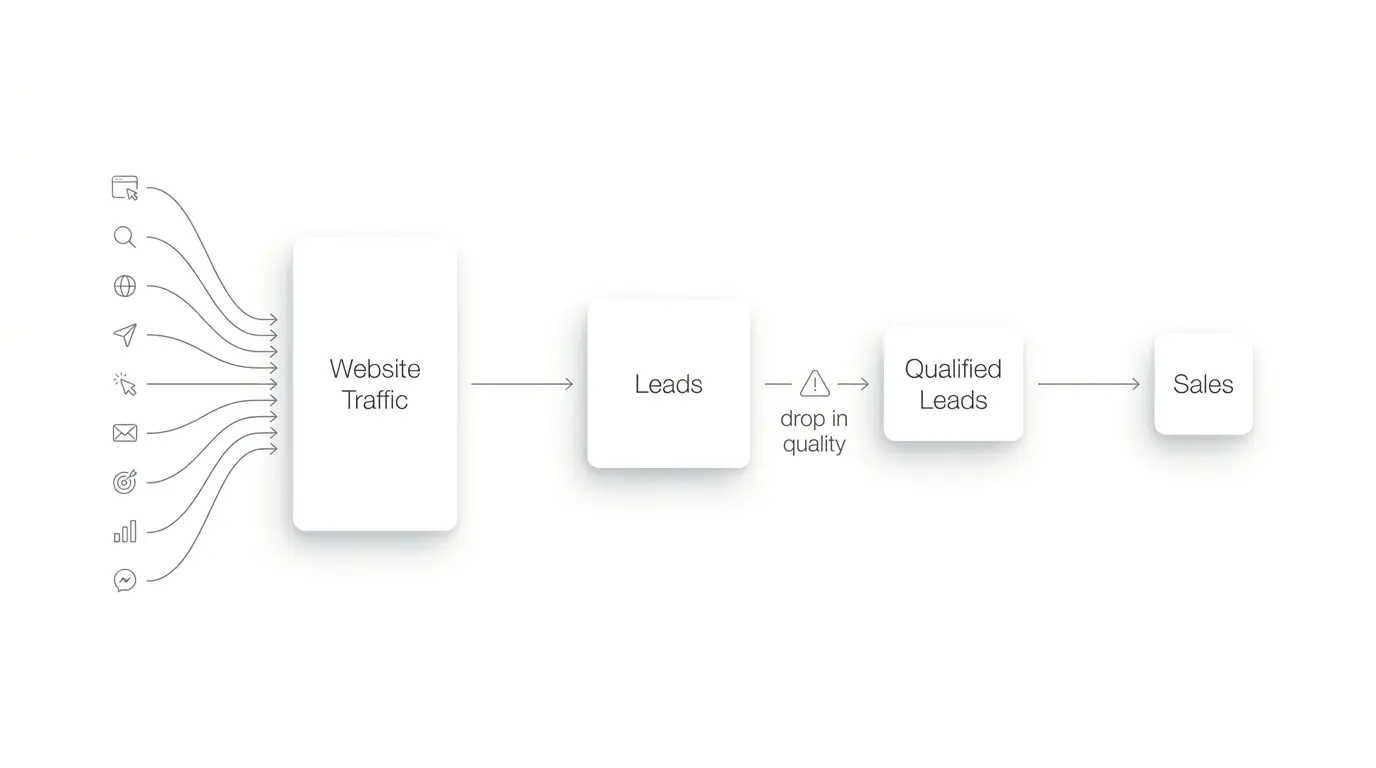
A well-designed lead generation architecture tightens each handoff, from click to form to CRM to follow-up. That is exactly what a focused lead generation services model tries to solve: fewer leaks, better qualification, and cleaner feedback into your campaigns.
Attribution gaps
Attribution gaps appear when you cannot clearly see which source created the lead, which campaign created the opportunity, and which touchpoint created the sale. Without that structure, business teams often over-credit the channel that generated the click and under-credit the system that created the conversion.
Consequently, this is why reporting often feels optimistic while revenue remains flat. The company is measuring activity, not business movement.
Landing Page Mismatch Reduces Enquiry Intent
The landing page is where intent either sharpens or collapses. If the message on the ad or search result promises one thing and the page delivers something broader, longer, or less specific, the user loses momentum. This is one of the most direct reasons why leads do not convert.
A premium landing page should reduce decision friction. It should confirm the problem, explain the outcome, show proof, and make the next step obvious. If it does not, even high-intent traffic can stall. That is why the right website structure is not cosmetic; it is a conversion asset that shapes enquiry behaviour.
For businesses that want a stronger conversion experience, working with a team that understands structure, clarity, and performance through conversion-focused website development can materially improve lead behaviour.
Landing page behaviour
Users scan. They do not read every word. They look for immediate relevance, visual trust, a simple offer, and a clear next action. If they cannot find those signals quickly, they leave. Therefore, page speed, mobile layout, headline clarity, and form simplicity all influence lead generation success.
The page must also reflect the exact commercial stage of the visitor. A cold audience needs reassurance and context. A warm audience needs proof and specificity. A hot audience needs a direct next step. When one page tries to serve all three, it usually serves none well.
Why Businesses Scale Too Early
Many businesses add budget before they add control. They see some traffic, some form fills, and some enquiries, so they assume the system is ready to scale. In reality, the lead quality may still be unstable, response times may be slow, and attribution may still be blind.
Scaling too early makes every weakness more expensive. More spend amplifies bad targeting, more impressions spread the wrong message further, and more leads overwhelm a team that is already slow to respond. That is how business lead quality issues become financial issues.
Lead systems should be improved before they are expanded. Otherwise, the business buys more noise and calls it growth.
Wrong Audience Intent Reduces Lead Quality
Wrong audience intent is one of the biggest lead generation problems for business owners. A campaign can reach a large audience and still attract the wrong people. This happens when targeting is too broad, creatives are too generic, or keywords are not separated by intent stage.
The result is predictable. The click-through rate may look fine, but the people arriving are not ready to enquire. They may be browsing, comparing, researching, or simply curious. None of these behaviours should be mistaken for buying readiness, and that is another reason why leads do not convert.
This is also the reason some accounts show great traffic but weak lead quality. They are optimized for the wrong audience signal. If the campaign attracts users who were never likely to convert, the business should not blame the landing page alone.
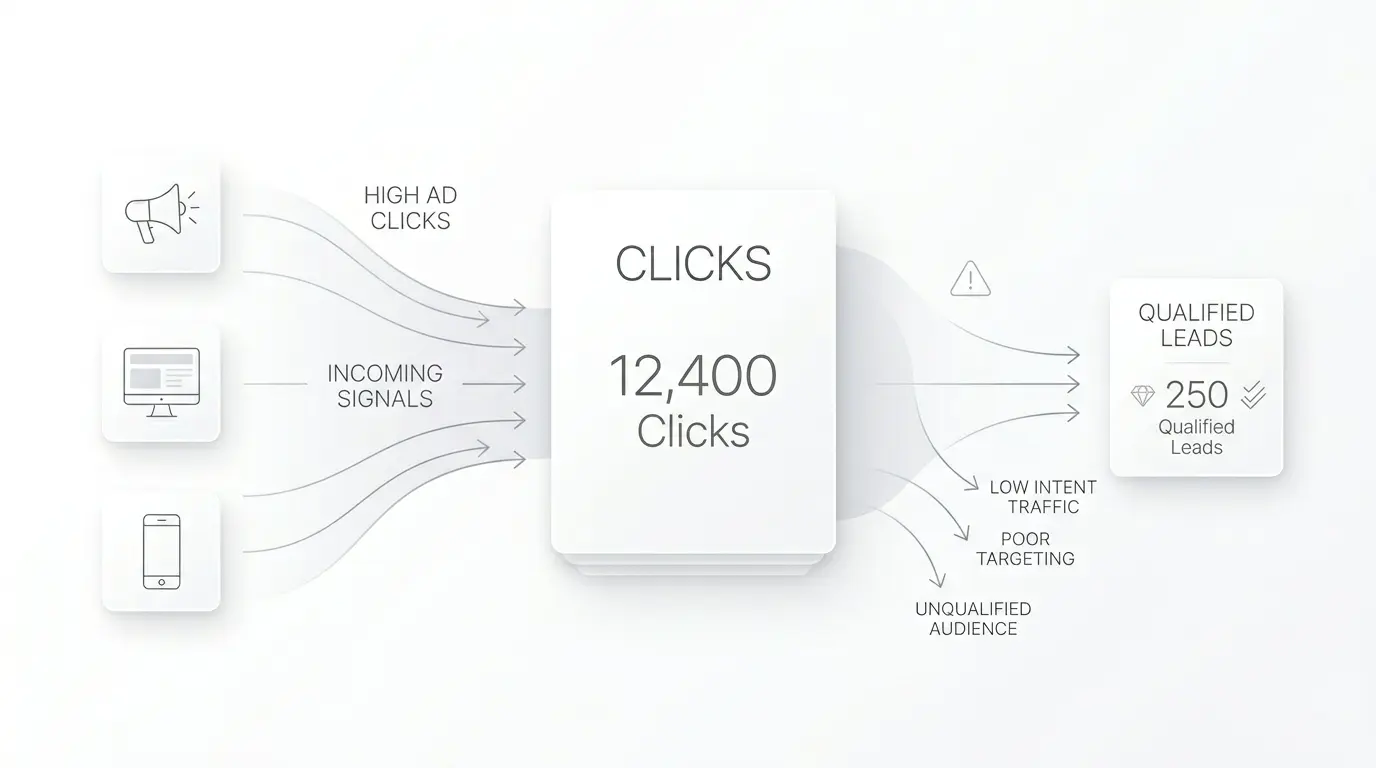
Why ads generate clicks but not qualified leads
Ads often generate clicks because they are designed to attract attention, not just close sales. That is useful, but only if the traffic is filtered into a meaningful next step. Without qualification logic, the ad system may keep optimizing toward people who click easily but never convert.
To improve quality, businesses should define what a qualified lead looks like before scaling. That usually includes geography, budget fit, service need, decision stage, and urgency. Once those criteria are clear, the campaign can be built to attract them more consistently.
Why Ads Generate Clicks But Not Qualified Leads
When you rely only on surface metrics, it is easy to misread why ads generate clicks but not qualified leads. The creative and targeting might be strong enough to win the click, yet the underlying intent does not match your offer, so the user quietly exits. In other words, the campaign performs on paper but fails at the level that matters most: qualified pipeline.
Additionally, many accounts still optimize purely for clicks or basic conversions instead of qualified leads. Google Ads qualified lead guidance encourages advertisers to set up dedicated qualified-lead and converted-lead events that reflect real business stages instead of shallow actions. When you combine that with clear CRM rules for why leads do not convert, you get a cleaner path from click to opportunity.
Finally, without clear content on the landing page about who the service is and is not for, unqualified visitors still complete forms and clutter your CRM. The fix is simple but strategic: tighten messaging, refine targeting, and align your tracking with what truly defines a good lead in your business.
Real Example of Lead Loss
A service business runs Google Ads and gets 1,200 clicks in a month. The account shows steady traffic, and the team feels positive because form fills are also increasing. But when they review the CRM, most leads are students, job seekers, or very small-budget enquiries. Very few are sales-qualified.
What happened? The keyword set was broad, the ad copy was generic, the landing page did not filter intent, and the sales team responded slowly. The business was not suffering from one failure. It was suffering from a chain reaction, which makes it easier to see why leads do not convert.
That is exactly why a case study view matters. Real funnel behaviour is rarely visible in a single dashboard. It only becomes obvious when the lead path is reviewed end to end. If you want to see how a system should be interpreted, review the structure in the MyProHub lead generation case study.
Expert Lead Audit Framework
A serious audit should reveal where the leak begins and where it becomes expensive. The aim is not to collect more dashboard data. The aim is to restore lead quality logic from impression to closed deal.
1. Check audience intent
Review which keywords, targeting sets, or audience segments are producing the most clicks. Then ask whether those clicks come from people ready to buy, people still comparing options, or people with no commercial fit.
2. Check message-match
Compare the ad promise with the landing page headline, offer, and form. If the message changes too much between steps, the user feels friction and leaves, and that is often why leads do not convert even though traffic looks solid.
3. Check tracking depth
Confirm whether the business tracks only leads, or also qualified leads and closed outcomes. Deep tracking matters because it improves reporting and gives the platform better learning signals.
For businesses that want this layer built correctly, analytics and conversion tracking services in India can connect campaign activity to actual business results rather than surface-level form fills.
4. Check CRM response time
Slow response loss is one of the most underestimated problems in lead generation. A strong lead can decay quickly if no one contacts it while interest is still high. Fast follow-up often matters as much as the ad itself.
5. Check qualification rules
If every enquiry is treated as equal, reporting becomes noisy. A business should define what makes a lead qualified, what makes it sales-ready, and what makes it a dead end. That structure improves decision-making across marketing and sales.
At a tactical level, this is where Google Ads account structure, offline conversion imports, and CRM hygiene must work together. Google Ads qualified lead guidance explains that qualified leads and converted leads allow you to track Google-generated leads that your CRM or sales team have already vetted or closed, which then feeds smarter optimization. You can learn more in Google official conversion documentation, and you can see how conversion events inform campaign decisions in Google Ads qualified lead guidance.
What Strong Lead Systems Do Differently
High-performing systems do not just collect traffic. They shape it. They filter it. They route it. Then they score it. That is the difference between a marketing setup that creates motion and one that creates revenue.
Strong systems align search intent, ad intent, page intent, and sales intent. They also remove ambiguity from reporting so the team can see what actually works. When that happens, budget starts buying better outcomes instead of more clutter.
If your campaigns already have visibility but not enough lead quality, a better ad strategy may also help. In many cases, that means restructuring targeting and offer logic through Google Ads services in India or Meta Ads strategy built around qualification, not just reach.
Modern lead generation services in India now combine ads, analytics, CRM logic, and landing page strategy into one framework so that every rupee you spend teaches the system who your best leads actually are.
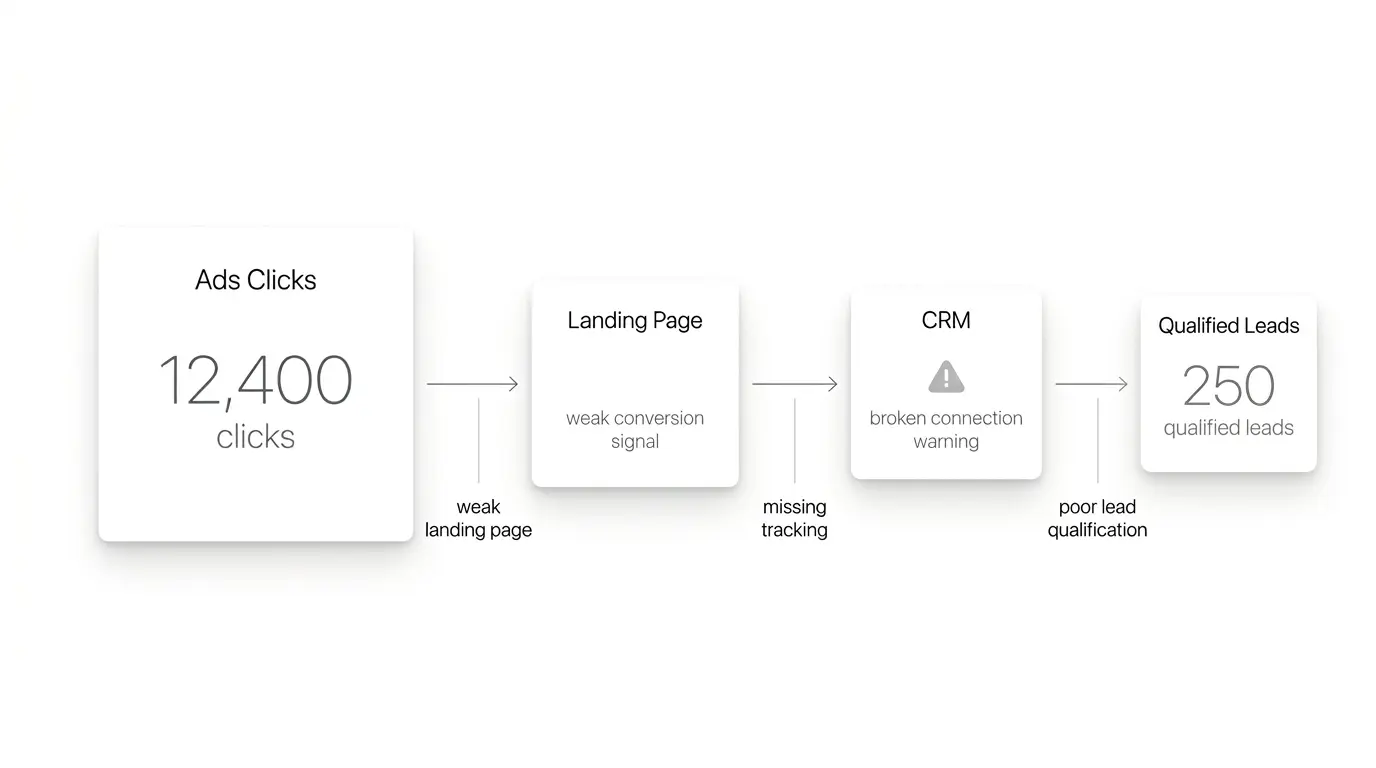
Why Good Traffic Still Fails Without System Design
Some businesses assume traffic itself is the asset. In reality, traffic only becomes valuable when the system knows how to turn attention into action. That is why budget alone cannot solve weak lead flow. The system must be designed to qualify, capture, and follow up with precision.
Lead systems are not built on hope. They are built on structure, speed, and measurement. If you are already seeing signs of traffic but no meaningful pipeline, the next improvement is usually not more spend. It is better diagnosis, stronger attribution, and a cleaner conversion path.
For a deeper breakdown of how weak measurement distorts outcomes, this related article on why good ads fail without tracking is a useful next read before you increase budget again.
Ready to Build Lead Systems That Convert Properly?
At MyProHub, we build lead systems with tracking, optimisation logic, and growth structure through specialised lead generation services in India. If your business gets traffic but not enough qualified enquiries, the fix is usually not more clicks. It is a better conversion architecture.
If your business needs stronger lead systems, talk to a digital growth partner before increasing ad budget. Traffic creates visibility. Lead systems create business movement. Clicks create activity. Qualified leads create scale.
You can also talk to a digital growth partner if you want a guided audit of why your business gets traffic but no leads.
WhatsApp: 9828303537
Email: [email protected]
FAQ
Why does traffic fail to generate leads?
Traffic fails to generate leads when intent, message, landing page, or tracking are misaligned. In many of these situations, this is exactly why leads do not convert even though analytics show healthy sessions.
Why do ads generate clicks but not qualified leads?
Ads often generate clicks because they attract attention, but attention is not the same as purchase intent. If targeting is too broad or the offer is not specific enough, the campaign will create activity without quality, and that gap explains why leads do not convert at the rate you expect.
Why is tracking important for lead generation?
Tracking shows which traffic sources produce real business outcomes, not just visits or form fills. Without deep tracking and lead quality logic, it becomes difficult to see why leads do not convert and which improvements will actually move revenue.
Can landing pages improve lead quality?
Yes. A focused landing page can filter the wrong audience, reinforce the offer, and reduce friction before the form submission. When you align the page with intent, you often fix why leads do not convert despite strong ad metrics.